
Updated September 2026
There is no single “best” way to sell a property. The right method depends on the likely buyer pool, the property’s presentation and uniqueness, current market depth, the seller’s timing, the level of privacy required and the seller’s tolerance for uncertainty.
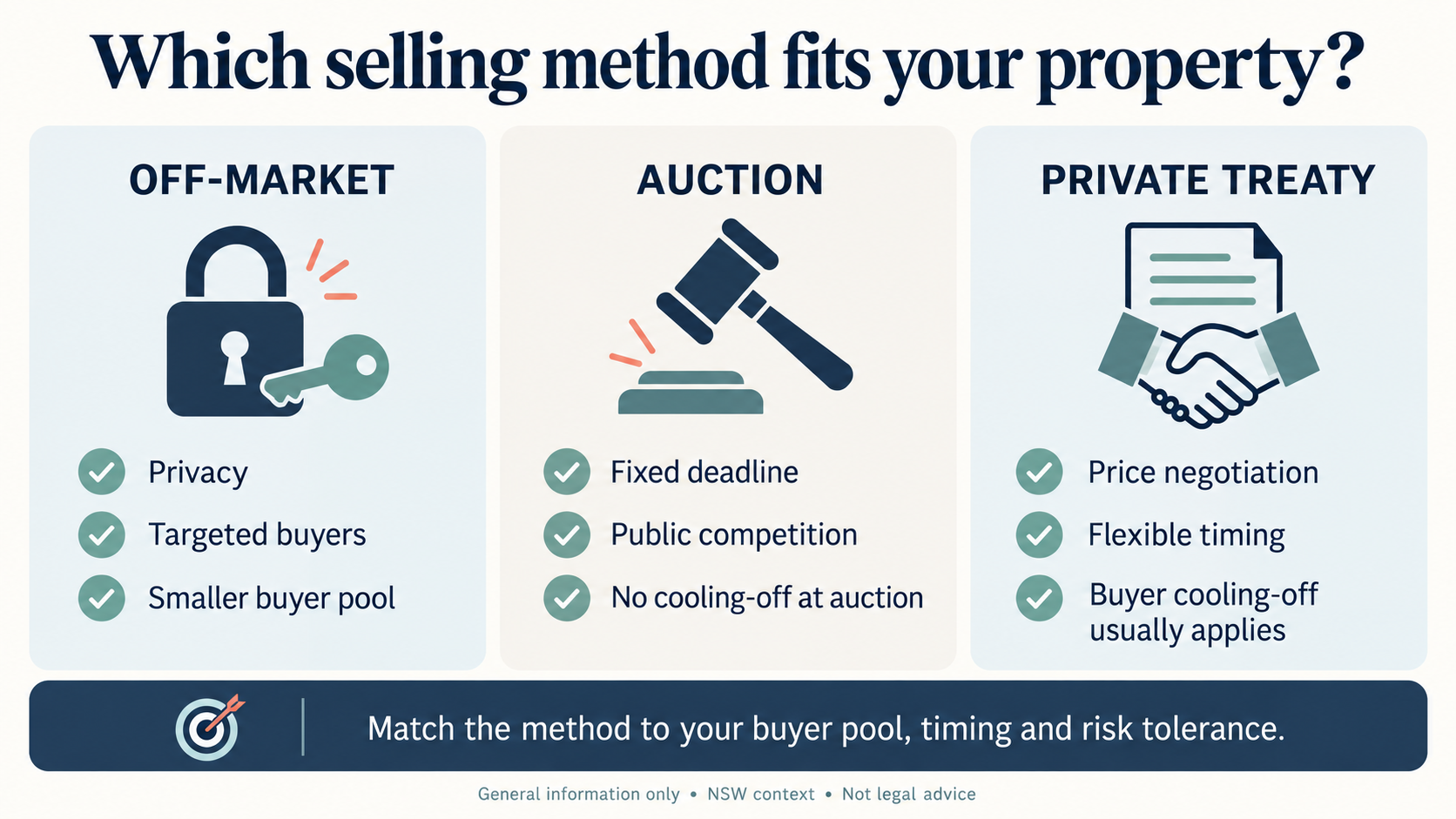
In NSW, auction and private treaty are the two main residential sale methods. Off-market is generally a marketing approach rather than a separate legal form of sale: an off-market property may still be sold by negotiated private treaty.
The practical question is not simply which method might achieve the highest price. It is which method is most likely to create the right balance of competition, certainty and negotiating flexibility for this particular property.
1. Off-market sale
What does off-market mean?
An off-market campaign limits public exposure. Instead of immediately advertising across major property portals and public channels, the agent may introduce the property to selected buyers, previous clients, local contacts and qualified database members.
The campaign may be completely private, or it may be used as a short pre-launch phase before moving to a broader auction or private treaty campaign.
Advantages
- Privacy: fewer public inspections, online discussions and enquiries.
- Speed and flexibility: a motivated buyer may allow the seller to negotiate timing, settlement terms and inclusions quickly.
- Early market testing: feedback can be gathered before committing to a full public campaign.
- Potentially lower broad marketing spend: although professional presentation, targeted marketing and agent fees may still apply.
Limitations
- A smaller buyer pool: the result depends heavily on the quality of the agent’s database.
- Less transparent price discovery: fewer competing offers can make market value harder to test.
- Dependence on the right buyer: the method works best when there is already demand for that particular property.
- Risk of accepting too early: a fast offer should be compared with a realistic estimate of what broader exposure could achieve.
What properties may suit off-market?
Off-market may suit prestige homes where privacy matters, unique properties with a specialist buyer pool, tenanted homes where inspections need to be limited, time-sensitive sales, or owners who want to test demand before a public launch.
For a standard family home in a strong market, limiting exposure too early may reduce competition. Ask the agent how many realistic buyers have been identified, not simply how large the database is.
2. Auction
How does an auction work?
An auction creates a fixed sale date and invites registered buyers to compete publicly. The seller sets a reserve price, generally not disclosed to buyers. If bidding reaches the reserve, the property is sold when the auctioneer’s hammer falls. If it does not, the property may be passed in and negotiations can continue.
In NSW, a successful auction bidder generally signs the contract and pays the deposit immediately. There is no cooling-off period for a buyer who purchases at auction. The same generally applies when contracts are exchanged on the day after a property is passed in. See the NSW auction guidance.
Advantages
- Creates urgency: a set auction date encourages buyers to make decisions.
- Can generate competitive tension: several motivated buyers may compete in public.
- Clearer price discovery: the seller can observe actual bidding rather than relying only on private offers.
- Useful for unique properties: scarce homes can be difficult to price by comparison alone.
Limitations
- No guaranteed result: a property may be passed in if bidding does not reach the reserve.
- Higher preparation requirements: photography, advertising, inspections and auctioneer costs need to be budgeted.
- Public outcome: a weak auction result may affect buyer perception.
- Buyer readiness: buyers usually complete legal and financial due diligence before bidding because there is no cooling-off period.
What properties may suit auction?
Auction may suit highly desirable homes in competitive suburbs, renovated or architecturally distinctive properties, scarce waterfront or lifestyle homes, and properties likely to attract several emotionally motivated buyers.
It may be less suitable when the buyer pool is narrow, the property has significant defects or the seller needs highly conditional negotiations.
3. Private treaty
How does private treaty work?
Under private treaty, the property is marketed with a price or price guide and buyers submit offers. The seller can negotiate price, settlement date, inclusions and other contract terms.
NSW Fair Trading explains that private treaty gives sellers more control, time to consider offers and the ability to keep the property on the market for an extended period. However, pricing too high can discourage buyers, while pricing too low may reduce the final result.
For most residential private treaty purchases in NSW, the buyer usually has a five-business-day cooling-off period after exchange. It may be waived, reduced or extended in certain circumstances, while the seller does not receive the same cooling-off right. The NSW sale process guide explains these rules.
Advantages
- Greater control over terms: offers can be assessed on price, settlement, finance and conditions.
- Suitable for many property types: including houses, apartments, land and investment properties.
- More time for decision-making: the seller is not committed to one auction date.
- Staged negotiation: feedback can be used to refine the campaign as buyer interest develops.
Limitations
- Pricing is critical: an unrealistic price can cause the property to sit on the market.
- Less visible competition: buyers may not know what others are offering.
- Offers can be difficult to compare: a higher offer may include more conditions or a slower settlement.
- Exchange still matters: the parties are generally not legally bound until signed contracts are exchanged.
What properties may suit private treaty?
Private treaty may suit ordinary family homes with a broad but price-sensitive buyer pool, apartments and strata properties, homes requiring more explanation or due diligence, properties with tenancy or settlement complexities, and land or house-and-land opportunities where buyers need time to review plans and contracts.
Quick comparison
| Seller priority | Method that may fit |
|---|---|
| Maximum privacy and a targeted buyer search | Off-market |
| A fixed deadline and public competition | Auction |
| Control over price, conditions and timing | Private treaty |
| Testing demand before a full campaign | Off-market pre-launch |
| A unique property with several motivated buyers | Auction |
| A property requiring detailed buyer due diligence | Private treaty |
How to choose the right method
Before selecting a method, consider:
- How many realistic buyers are likely to exist?
- Is the property rare enough to create competition?
- Does privacy matter more than maximum exposure?
- How quickly does the seller need to settle?
- Is the property easy to compare with recent sales?
- Are there defects, tenancy issues or contract complexities?
- Would buyers benefit from more time to review the opportunity?
- What is the fallback plan if the property does not sell immediately?
A hybrid strategy can also be effective. An agent may begin with a confidential buyer approach, gather feedback and then move to a public private treaty or auction campaign if the initial response is not strong enough.
NSW compliance still matters
Regardless of the selling method, NSW sellers should arrange a compliant contract before advertising, disclose known issues and provide required certificates where applicable. A licensed agent must also use a reasonable estimated selling price and comply with underquoting rules. The NSW Government selling guide summarises these obligations.
NSW property and agent laws are changing in stages during 2026. Requirements relating to price representation and Statements of Information are being introduced progressively, so sellers should confirm the current requirements with their agent and legal adviser before launching a campaign. See the NSW Fair Trading update on the 2026 reforms.
How Crest Realty helps sellers choose
Crest Realty helps sellers assess the property, the likely buyer pool and the best campaign structure before recommending a method.
Our process considers recent comparable sales, property presentation, buyer demand, likely objections, privacy preferences, timing, settlement requirements and the level of competition a campaign can realistically create.
The best selling method is not always the most aggressive one. It is the method that gives the property the right exposure, reaches the right buyers and supports disciplined decision-making.
Conclusion
Off-market, auction and private treaty each have a legitimate place in the NSW property market.
Off-market can provide privacy and speed, but may limit competition. Auction can create urgency and competitive tension, but requires preparation and buyer readiness. Private treaty offers flexibility and control, but depends heavily on accurate pricing and strong negotiation.
The right choice should be based on the property’s characteristics, the buyer pool, the market conditions and the seller’s objectives—not on a one-size-fits-all rule.
Disclaimer: This article provides general information only and is not legal, financial, tax or investment advice. Selling rules, disclosure obligations, advertising requirements and market conditions may change. Sellers should obtain independent advice from a solicitor or licensed conveyancer and confirm current requirements with their NSW-licensed agent.