
Updated September 2026
For a property investor, refinancing is more than switching to a lower interest rate. Used carefully, it can reduce the cost of existing debt, improve loan structure, release a portion of usable equity and create more flexibility for the next investment decision.
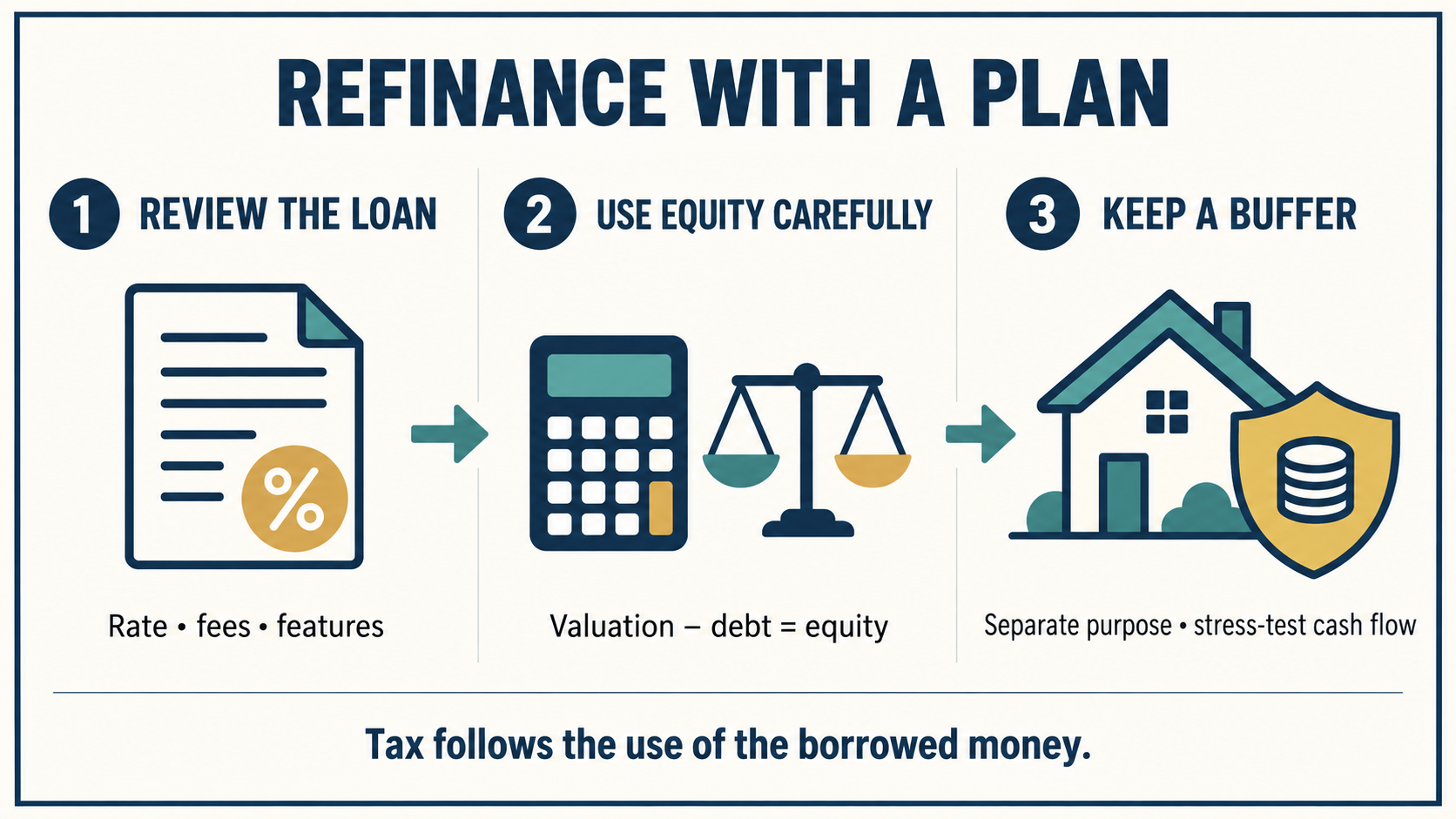
It is also a form of leverage. A lower rate or a higher valuation does not remove the risks of vacancies, repairs, rising repayments, changing lender policy or falling property values. The strongest refinance strategy is therefore one that improves the portfolio while preserving a meaningful cash-flow and liquidity buffer.
What does refinancing mean?
Refinancing replaces an existing loan with a new loan. The new loan may be with the same lender or a different lender, and it may change the interest rate, repayment type, loan term, offset features, loan splits or amount borrowed.
For investors, the reason for refinancing should be written down before comparing products. “Get a better rate” is one objective. “Release a defined amount of equity for a specific investment, while keeping the existing investment debt clearly documented” is a much more useful objective.
Four ways refinancing may help an investor
1. Reduce the cost of existing debt
A lower interest rate can improve an investment property’s cash flow, but the rate is only one part of the comparison. Check the ongoing fee, annual package fee, offset availability, redraw rules, fixed-rate conditions, repayment type and the total cost over the period you expect to hold the loan.
Include discharge fees, application fees, valuation costs, legal costs, broker fees, possible fixed-rate break costs and any lender’s mortgage insurance. ASIC Moneysmart’s switching-home-loans guide notes that a cheaper rate may not be worthwhile if switching costs outweigh the saving.
A simple break-even check is useful: divide the total switching cost by the expected monthly saving. If the result is longer than your likely holding period, refinancing may not improve the outcome.
2. Release equity for a defined investment purpose
Equity is not the same as cash. A lender may calculate borrowing capacity using a valuation, an acceptable loan-to-value ratio (LVR), your income and expenses, existing commitments and its own credit policy.
For illustration only, if a property is valued at $1,000,000 and the existing loan is $600,000, a 70% maximum LVR would imply up to $700,000 of total debt. The theoretical amount above the existing loan is $100,000, before transaction costs and lender limits. A valuation can be lower than expected, and the lender may approve less—or nothing—after its serviceability assessment.
Released equity should have a job. It might fund part of a deposit, due diligence, a renovation that supports rentability or a carefully planned house-and-land purchase. It should not be treated as an invitation to buy the most expensive property a lender will approve.
3. Improve the structure and visibility of the portfolio
Refinancing can be an opportunity to separate loans by property and by purpose. Separate splits make it easier to see the balance, interest rate and cash flow of each investment. They also reduce the risk of accidentally mixing investment borrowings with private spending.
An offset account can provide flexibility for cash that may be needed for vacancies, repairs, tax or the next purchase. A redraw facility may operate differently from an offset, so investors should understand how withdrawals and repayments are treated by the lender and keep a clear transaction history.
Cross-collateralising several properties may appear convenient, but it can reduce flexibility when selling or refinancing one asset. Ask whether the proposed structure lets you manage each property independently.
4. Create time and flexibility for the next purchase
A refinance can give an investor a longer runway to research the next opportunity rather than rushing to buy after a valuation increase. It may also allow a pre-approval or conditional approval to be arranged before a suitable property appears.
Approval is not a reason to purchase. The next property still needs its own assessment of location, demand, realistic rent, maintenance, insurance, land tax, vacancy risk, exit options and contract terms. Moneysmart’s investment-property guidance warns that rent may not cover all ownership and borrowing costs and that property should fit an overall plan and risk tolerance.
Tax: the purpose of borrowed money matters
Refinancing does not automatically make interest deductible. The Australian Taxation Office generally looks at what the borrowed funds are used for, not simply which property secures the loan or whether the loan is labelled “investment”.
If an investment loan is refinanced and part of the new borrowing is used for a private purpose, the interest must generally be apportioned. The same issue can arise when an investor redraws from an investment loan for private spending. The ATO rental-property guidance explains that interest relating to private use is not deductible and that accurate records are required where a loan has mixed purposes.
Practical safeguards include using separate loan splits for separate purposes, directing investment borrowings to a dedicated account, keeping settlement statements and invoices, and asking an accountant how repayments and future redraws should be recorded. Loan interest, borrowing expenses and capital costs can have different tax treatment. Do not rely on a lender, agent or online calculator for personal tax advice.
Stress-test the plan before signing
A refinance should be tested against the conditions that could make the portfolio uncomfortable:
- Higher rates: model a meaningful increase, not just today’s quoted rate. APRA’s APS 220 standard requires authorised deposit-taking institutions to apply a serviceability buffer over the loan rate, but a lender’s approval test is not a guarantee that your personal cash flow will remain comfortable.
- Vacancy: allow for a realistic period without rent and for reletting costs.
- Ownership costs: include management fees, insurance, council and water charges, strata if relevant, land tax, maintenance and major repairs.
- Repayment changes: check when an interest-only period ends, when a fixed rate expires and whether the loan term has been extended.
- Income changes: consider parental leave, self-employment volatility, reduced overtime or a change in household expenses.
- Valuation risk: a lower valuation can increase the LVR and reduce the equity available for another purchase.
The question is not “Can the bank approve this?” It is “Could I still hold the portfolio if rent fell temporarily, a major repair arrived and rates were higher than expected?”
When refinancing may not be the right move
Refinancing may add little value when the rate saving is small, the switching costs are high, a fixed-rate break fee is substantial or the investor expects to sell soon. It may also be unsuitable when a new lender’s valuation or serviceability policy does not support the proposed structure.
Be cautious about extending the loan term simply to reduce the monthly repayment. That can increase the total interest paid. Be equally cautious about using equity to fund lifestyle spending, speculative renovations or a purchase that only works under optimistic rent and growth assumptions.
A disciplined refinance process
- Define the objective: lower cost, restructure, release a specified amount, or prepare for a particular acquisition.
- Collect the evidence: current loan statements, property details, rent and expense records, income documents and a list of all debts.
- Obtain a realistic valuation view: use recent comparable sales and treat an online estimate as a starting point only.
- Compare the whole loan: rate, fees, features, term, repayment type, exit costs and flexibility.
- Structure the borrowings: keep property and private purposes separate and document the intended use of each split.
- Run the stress test: model higher rates, vacancy, repairs and the end of any interest-only period.
- Set a cash reserve: retain funds for ownership costs and unexpected events after settlement.
- Review regularly: monitor the actual rate, rent, repayments, LVR and portfolio concentration rather than waiting for the next purchase.
Illustrative numbers—not a recommendation
Suppose an investor refinances a $600,000 loan from 6.50% to 5.90%. The simple gross interest difference is about $3,600 per year before fees, tax and changes in the loan balance. If switching costs total $3,000, the simple break-even period is roughly ten months. That calculation does not account for different repayment schedules, future rate movements, valuation changes or the investor’s tax position.
If the same investor also releases $100,000 for a future purchase, the portfolio has more debt and a new repayment obligation. The investment must be assessed on its own merits, and the reserve should remain available after deposit and purchase costs. The numbers illustrate the decision process; they do not predict a return.
How Crest Realty supports investor decision-making
Crest Realty helps investors assess the property side of the decision: realistic rental demand, comparable sales, location fundamentals, property presentation, likely holding costs and the suitability of a property within a broader strategy.
We can work alongside the investor’s mortgage broker, accountant and solicitor so that the finance structure, tax treatment and contract position are reviewed by the right professionals. We do not approve loans or provide personal financial or tax advice.
Key takeaways
- Refinance for a defined strategic reason, not simply because a headline rate looks lower.
- Release only the equity that the plan can support, and keep a genuine cash-flow buffer.
- Separate loan purposes and keep complete records; the use of the borrowed funds matters for tax.
- Test the portfolio against higher rates, vacancy, repairs and changing income.
- Do not let available equity replace independent research into the next property.
Disclaimer: This article provides general information only and is not personal financial, credit, tax, legal or investment advice. Lending criteria, interest rates, valuations, tax rules and property conditions can change. Before refinancing or acquiring property, obtain advice from an appropriately licensed mortgage broker or credit representative, accountant or registered tax agent, solicitor or conveyancer, and other advisers relevant to your circumstances.