
“What percentage do you charge?” is a useful question for a property manager. It is not enough to compare the complete proposals.
One agency may include a service in its ongoing fee; another may charge for it when a particular event occurs. Two identical percentages may also be calculated on different amounts. A low headline rate does not, by itself, establish the lowest overall cost or the most suitable service.
For a Sydney landlord, the aim is to understand what is charged, what triggers the charge, and what work you receive in return. Here is a practical way to compare written proposals without relying on an advertised percentage alone.
1. Establish what the percentage is calculated on
Before comparing rates, ask each agency to identify the calculation basis in the proposed agreement. Is the fee calculated on rent actually collected, another defined rental amount, or a wider category of receipts? What happens during vacancy or arrears? Is there a minimum or fixed charge?
Ask for a worked calculation using the same rental assumptions. A phrase such as “management fee” is not a complete definition of how the amount is derived. If a proposal uses a different basis, leave that difference visible rather than treating the percentages as directly interchangeable.
Also ask whether every quoted amount includes GST and whether any other mandatory charge applies. The ACCC's price-display guidance explains total-price disclosure, including taxes and unavoidable fees, as well as the treatment of optional or not-yet-quantifiable charges. For your own comparison, request figures on the same GST basis and identify amounts that cannot yet be calculated.
Do not confuse the property's rental income with the management company's fee. If you are still assessing a realistic rent, start with our Sydney rental-appraisal guide rather than using an optimistic rent to make a proposal look more attractive.
2. Separate ongoing costs from charges triggered by an event
Ask for the complete proposed fee schedule, not just a summary email or the first line of a brochure. Mark each item as included, separately charged, not applicable, or awaiting clarification. “Not mentioned” is not the same thing as “included”.
Read ongoing management charges separately from letting, advertising, tenancy- agreement preparation or renewal charges. Ask about statements, inspections, maintenance coordination, Tribunal attendance and ending or handing over the management. Do not assume that every agency imposes each charge, or that every proposal covers the same work.
The NSW Government landlord-management guide explains that the management agency agreement records the percentage and other required fees. It identifies possible additional costs such as advertising, agreement preparation and Tribunal representation. The actual written proposal must establish what applies to your property.
For every separate charge, record the amount or formula, the trigger, when it is payable and the document clause. For an hourly item, ask how time is recorded and whether an estimate or approval is required. This is a clarification list, not a finding that a particular fee is lawful or payable in every circumstance.
3. Test the same proposals against more than one scenario
A simple illustration shows why the tenancy events matter.
Everything in the following example is fictional. These are not Crest Realty fees, actual agency quotations, typical Sydney rates or a rental forecast. Assume, solely for the calculation, $750 rent is collected for each of 52 weeks: $39,000 in the comparison period. Both proposals calculate management fees on that same collected rent. All illustrated fee figures and percentages include GST where applicable; do not add GST again.
| Specified item | Fictional Proposal A | Fictional Proposal B |
|---|---|---|
| Management percentage on the same collected rent | 5.5% | 6.6% |
| Calculated management fee on $39,000 | $2,145 | $2,574 |
| Fixed administration charge for the period | $180 | Included |
| Additional charge if one new letting occurs | $900 | $500 |
| Advertising charge for that new letting | $250 | $250 |
Now use two different event assumptions over the same comparison period:
| Illustration only | Proposal A subtotal | Proposal B subtotal |
|---|---|---|
| Continuing tenancy; no new letting or advertising event | $2,325 | $2,574 |
| One new letting and its advertising event | $3,475 | $3,324 |
For the continuing-tenancy scenario, A's specified charges are $249 lower. With the illustrated letting and advertising added, B's specified charges are $151 lower, despite the higher management percentage.
Those are partial fee subtotals, not a complete ownership budget or a recommendation for a real agency. The calculation assumes the stated rent is collected in full; it does not model vacancy, arrears or the timing of rental receipts. A letting event does not guarantee immediate occupancy. Other event charges and any difference in service scope have not been priced.
For a real comparison, replace all inputs with the actual written proposals and realistic rental assumptions. Do not add a service fee again if the agreement already includes it. Change the number of events and the collected rent to test the effect; unknown costs should remain unresolved, not become zero by default.
4. Compare the work and accountability alongside the cost
A spreadsheet does not establish how a tenancy will be managed. Ask each agency to explain who is responsible for the work, what information you will receive and what requires your decision.
Useful discussion points include:
- who manages the property day to day and who provides cover;
- how rent arrears and tenant requests are recorded and escalated;
- what inspection and owner reports contain;
- how repair quotations, approvals, invoices and completion are tracked; and
- how you can review an unexpected charge or unresolved issue.
Ask what is included in the proposed scope and what attracts another fee. Where a sample report is useful, request a blank or properly de-identified example, not another owner's or tenant's private records.
Do not assume that the highest fee proves the best service, or that the lowest fee necessarily means poor management. Assess the proposed scope and evidence. An agency appointment is not a guarantee of rent, occupancy, tenant conduct or an investment return.
5. Read the agreement, including what happens when circumstances change
NSW Government guidance says landlords using an agent need a written management agency agreement and that fees and conditions are negotiable. Ensure the responsibilities, authority and charges you have discussed are reflected in the document before signing, rather than relying on a verbal understanding.
Ask how changes to fees or service arrangements are handled. If a discount is offered, establish its duration, conditions and the charges that apply afterwards. Confirm the commencement date, notice provisions and any proposed handover charges; do not assume all agreements have the same terms.
If you are already using another agent, read our guide to switching property managers in NSW. That guide covers the handover process; a fee comparison alone is not a termination notice or authority to create overlapping appointments. Seek independent legal advice about unclear or disputed terms.
6. Keep management fees separate from the property's wider costs
Agent charges are only one part of the rental property's budget. Repairs, insurance, rates, strata levies where applicable, finance and other ownership costs need separate consideration. An invoice for a repair is not automatically a management fee, even if both appear on the owner statement.
Ask how contractor costs, agency coordination charges and any other relevant arrangements will be distinguished and disclosed. A written repair-authority limit should not be treated as a substitute for applicable tenancy obligations or an instruction to delay an urgent issue.
Do not offset a speculative “extra rent” or assumed tax deduction against a known fee to make the comparison work. Obtain rental evidence and advice about your own tax and financial position. Lower charges alone do not establish a better overall investment outcome.
7. Take this checklist to your next agency discussion
Before choosing a proposal, be able to answer:
- What amount is the management percentage applied to?
- Are figures on the same GST basis, with mandatory charges identified?
- Which services are included, excluded or still unclear?
- Which events create another charge, and when is each payable?
- What do the same proposals cost under different realistic tenancy scenarios?
- Who is responsible for the work and what reporting will I receive?
- How are fee changes, discounts, notice and handover terms documented?
- What remains uncertain, and who must clarify it before I sign?
Keep the answers beside the relevant agreement clause. If a provider cannot yet quantify an item, ask for the calculation method or information needed to resolve it. The objective is an understandable agreement, not simply a shorter list of numbers.
Discuss a property-specific proposal with Crest Realty
If you are comparing management options, explore our Sydney property management service or contact Crest Realty to discuss your property's location, type, occupancy and the help you are seeking. Ask for a written proposal explaining the relevant services and charges; this article is not a Crest Realty fee schedule or an offer at any illustrated rate.
Do not upload tenant records, identity documents, bank statements or signed agreements through the public website enquiry form. A first discussion does not require those documents.
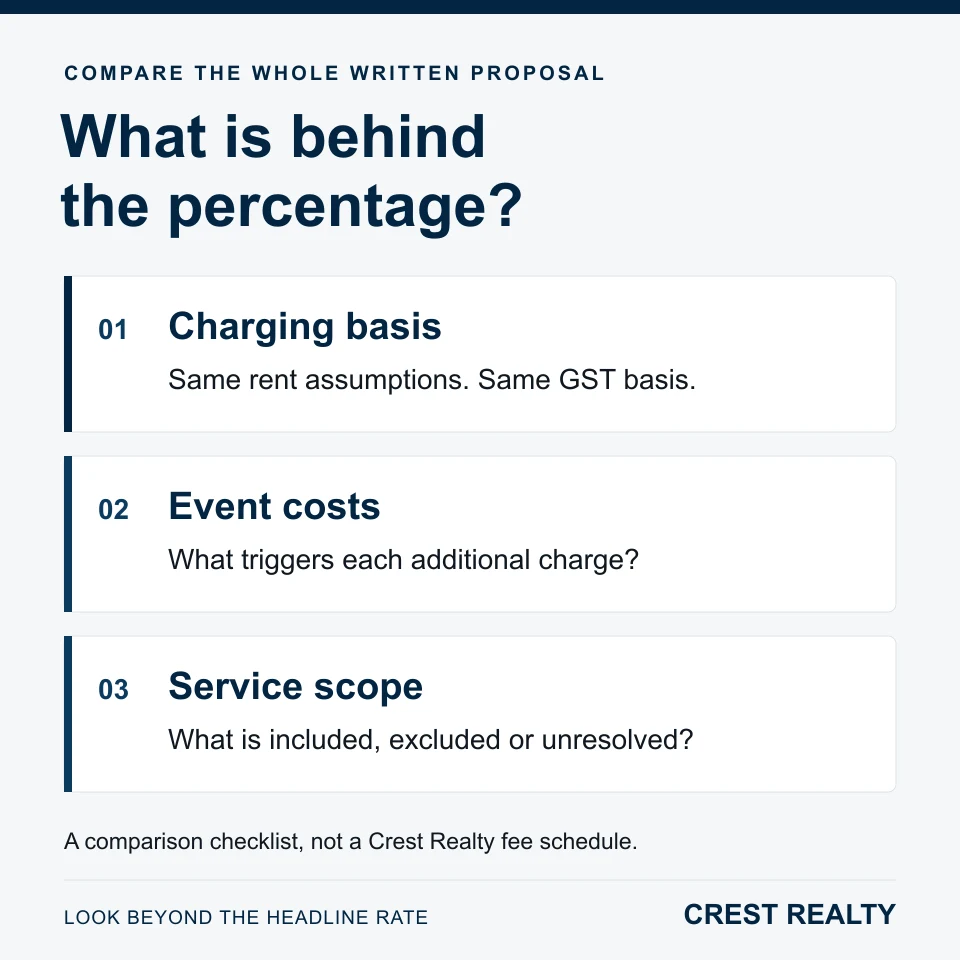
Compare the whole written proposal: the calculation, the event costs and the work behind the fee.
General information only. Official sources checked on 20 October 2026. All example rents, percentages and fees are invented solely to explain the calculation, not market estimates or current offers. This article is not legal, financial or taxation advice. Services, charges and outcomes depend on the actual agreement and circumstances; obtain appropriate independent advice before appointing or changing an agent.