
Policy information checked 26 October 2026.
Yes, an eligible Sydney buyer may be able to buy a home with a 5% deposit
through the Australian Government 5% Deposit Scheme. That can shorten the
deposit-saving stage. It does not make the other 95% free, establish what you
can afford or remove the need for lender approval.
The useful question is not simply, “Can I buy with 5%?” It is, “Can I cover
the complete purchase, repay the loan and meet the scheme's conditions?”
1. What the government scheme changes
Under the Australian Government 5% Deposit Scheme,
eligible first home buyers can purchase with a minimum 5% contribution and a
government guarantee supporting their participating lender. An eligible loan
does not require Lenders Mortgage Insurance (LMI).
Since 1 October 2025, the scheme has no income caps and no limit on places.
Those changes remove scheme access limits; they do not remove the bank's
assessment of your income and ability to repay.
The guarantee supports the lender. You remain responsible for the loan,
interest and other costs. It is not a government cash gift towards the
purchase price.
2. A 95% loan, a guarantee and shared equity are different
“95% loan” describes a loan-to-value ratio (LVR), not a particular government
program. Compare these arrangements before treating them as interchangeable:
| Arrangement | What it means for the buyer |
|---|---|
| Ordinary high-LVR home loan | A lender may lend a high proportion of the assessed property value under its own product rules. LMI may apply; confirm the actual offer and costs. |
| Australian Government 5% Deposit Scheme | Eligible buyers use a participating lender and government guarantee, avoiding LMI on an eligible loan. They still repay their home loan. |
| Australian Government Help to Buy | A separate shared-equity arrangement: government contributes towards the purchase and shares in changes to the value of its interest. Ongoing reviews and exit/buyback rules matter. |
Help to Buy's official guidance
explains the shared-value arrangement. Do not assume it can be combined with
the 5% Deposit Scheme, or that a government guarantee means the government owns
15% of your home.
For an ordinary loan, compare the total written offer rather than LVR alone.
ASIC Moneysmart's loan-selection guide
explains why interest rates, fees, repayment structure, loan term and features
all affect the cost.
3. Who may qualify for the first-home-buyer pathway?
The government's first home buyer eligibility page
sets out the main checks. Applicants must be at least 18 and Australian
citizens or permanent residents; meet the deposit and property conditions;
and buy a home to occupy rather than an investment property. You can apply
alone or with one other eligible person.
Property history matters: first home buyers and some people who have not held
Australian property interests for the previous ten years may qualify. The
full Information Guide
includes interests in land and certain other property interests, not only a
house you previously lived in. Joint applicants need their circumstances
checked together.
The guide generally requires savings of at least 5% but less than 20% of
assessed property value. A larger available contribution may be required;
buyers with 20% available after purchase costs are not eligible for this
pathway. Ask the lender how that applies to your genuine circumstances.
The loan also has eligibility requirements, including principal-and-interest
repayments, with limited construction-related exceptions. Do not assume the
scheme permits a permanent interest-only investment loan.
There is a separate pathway for eligible single parents and legal guardians,
with different conditions. This article concentrates on the 5% first-home-buyer
pathway rather than treating the two as the same application.
4. Sydney's price cap is not your borrowing limit
At the checked date, the official property-price cap table and postcode tool
show a $1,500,000 cap for NSW's capital city and specified regional centres,
including Sydney; other NSW areas have an $800,000 cap. Confirm the exact
suburb/postcode with your participating lender.
Both the purchase price and lender-assessed value must be within the relevant
cap. For separate land and construction contracts, the combined land and
building cost must also fit the cap. An eligible-looking land price alone
does not establish that the complete home qualifies.
The cap says whether a property is within the scheme's price boundary. Your
income, commitments and lender assessment determine whether a particular loan
is available. Treating $1.5 million as a personal spending target reverses the
order of those decisions.
5. Work out the cash required, not just the deposit
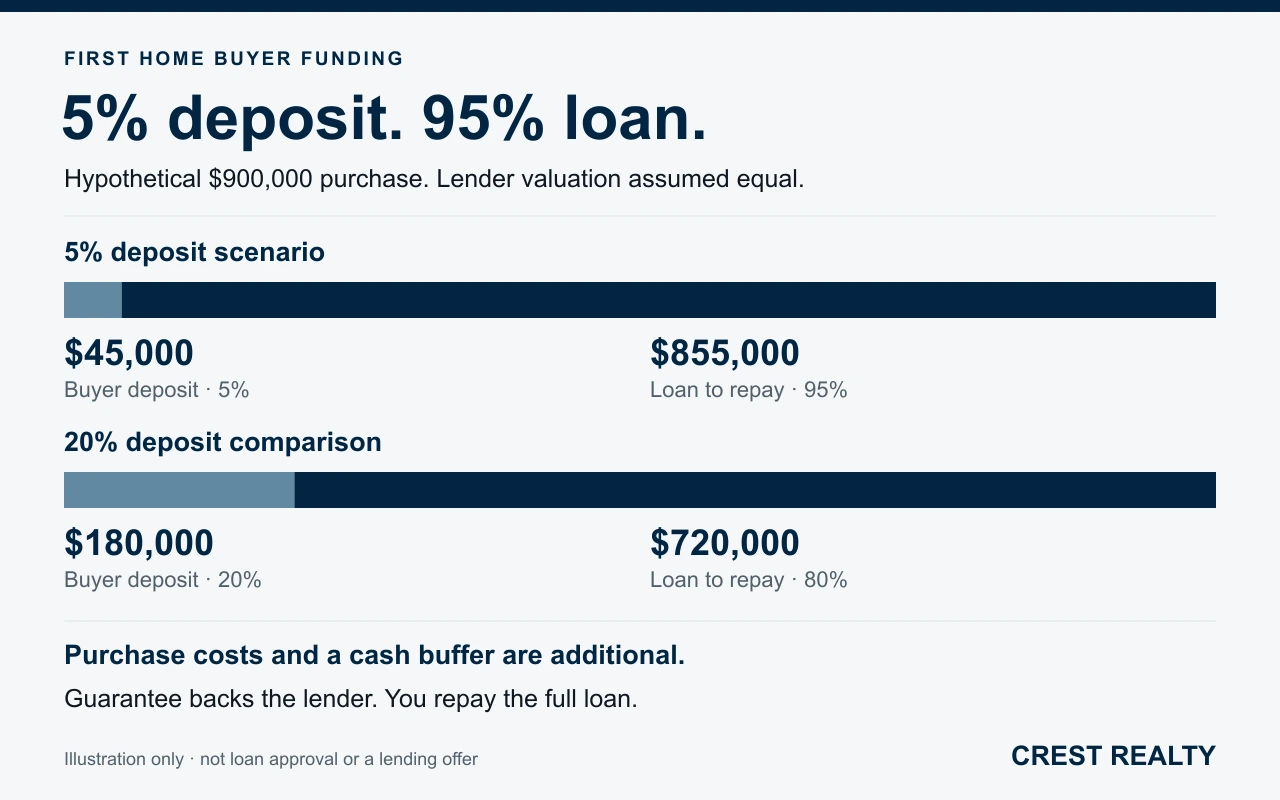
Consider a hypothetical $900,000 purchase, with an equal lender valuation
and a lender willing to approve the assumed loan:
- A 5% contribution is $45,000; the remaining purchase funding is an $855,000 loan.
- A 20% contribution is $180,000; the remaining purchase funding is a $720,000 loan.
- The smaller contribution leaves $135,000 more debt in this comparison.
This is arithmetic, not a lending offer, property valuation or recommendation
to use either contribution. The graphic compares purchase funding only.
Your cash worksheet should separately allow for transfer duty if payable,
conveyancing/legal work, inspections, lender and settlement charges, moving
costs, relevant settlement adjustments and an accessible buffer for ownership
costs. Obtain quotes and property-specific figures rather than treating a
generic allowance as the final cash requirement.
The government's scheme FAQ
also distinguishes the lender's assessed value from the price you agree to
pay. If the valuation is lower, the loan and cash calculation may change.
Ask your lender to confirm the position before relying on a 5%-of-price sum.
Use our NSW buying costs and cash needed calculator
as an initial worksheet, then reconcile its assumptions with the lender and
your solicitor or conveyancer. It does not assess scheme eligibility or
approve a loan.
6. Compare repayments and leave room for change
The following is another hypothetical illustration, using monthly
principal-and-interest repayments over 30 years, with no fees, offset balance
or extra repayments. The interest rates are assumptions, not current quotes.
| Scenario | Loan | Assumed annual rate | Approx. monthly repayment |
|---|---|---|---|
| 5% contribution | $855,000 | 6% | $5,126 |
| 20% contribution | $720,000 | 6% | $4,317 |
| 5% contribution, higher-rate check | $855,000 | 8% | $6,274 |
At the same assumed 6% rate, the larger loan costs about $809 more each
month. In the higher-rate example it requires about $1,148 more each month
than the first row. These rounded differences compare unrounded calculations;
actual lender schedules and charges can differ.
ASIC Moneysmart's house-buying guide
encourages buyers to consider what repayments leave for ordinary spending and
future plans, and to test a higher interest rate. Include council/water charges,
insurance, maintenance and strata levies where relevant in your wider budget.
You can change the inputs in our mortgage repayment calculator.
Compare rates and terms with a participating lender; this illustration is not
their serviceability assessment. Entering a smaller deposit into a calculator
does not mean the remaining loan will be approved.
7. Keep NSW duty relief and grants separate
Government loan support does not automatically qualify you for NSW benefits.
The NSW First Home Buyers Assistance Scheme
has its own property-value, ownership-history and occupation conditions. At
the checked date, eligible home purchases up to $800,000 can receive a full
duty exemption, with a concession above $800,000 and below $1 million.
Vacant land has different thresholds.
The separate $10,000 First Home Owner (New Homes) Grant
is for qualifying new-home transactions, with its own price limits and
conditions. It is not a payment for every first purchase or an established home.
The $900,000 hypothetical example does not establish a duty concession or
grant entitlement. Have each benefit checked separately before subtracting it
from the cash you expect to need.
For a side-by-side explanation, read our NSW first-home assistance overview. It separates duty relief, the new-home grant and government loan support so you can prepare questions about each program.
8. What to do before choosing a property
Start with an evidence-based shortlist rather than the maximum headline cap:
- Ask a participating lender to assess both scheme eligibility and lending capacity.
- Confirm your deposit, other cash costs and a repayment budget you can sustain.
- Check the specific property's price cap, valuation, type and transaction structure.
- Have your solicitor or conveyancer review the contract, deposit payment dates and protections before committing.
- Confirm final finance and scheme requirements, including the conditions for moving in and keeping the guarantee.
Under the scheme FAQ,
buyers generally need to move into an existing home within six months of
settlement and continue living there while the guarantee is active. New builds
have their own timing rules. If circumstances change, speak to the lender:
leaving the conditions unmet can lead to loss of the guarantee and additional
costs, including possible LMI.
For a house-and-land purchase, start with our South West Sydney process guide
and ask the lender to confirm construction eligibility and timing before
assuming a package fits the scheme.
Explore your next home with Crest Realty
Once your funding parameters are clearer, explore buying with Crest Realty
or review our land and house-and-land project information.
We can discuss the property, location, budget and timing you are looking for;
current opportunities and details need confirmation.
Contact our team about your property search. Your participating
lender determines loan and scheme approval; your legal and tax advisers can
help with the contract and individual entitlements. No Crest listing is
automatically represented as scheme-approved.
General information only, checked 26 October 2026. This article is not personal
credit, financial, tax or legal advice. Rules, lender policies, rates and costs
can change. Confirm current eligibility and property details with the relevant
government agency, participating lender and your independent advisers before
making a commitment.