
Owning an investment property can affect first-home assistance even if you never lived in it. But the result depends on the particular program. A duty concession, new-home grant, loan guarantee, shared-equity arrangement and super-saving scheme do not use one universal definition of “first home buyer”.
For a NSW purchase, check your ownership history, your spouse or co-buyer's position, and the rules of each program separately. Approval under one does not establish eligibility under another.
Rules checked: 27 October 2026. The comparisons below highlight ownership tests, not every eligibility condition. Final assessments sit with the administering agency and, where relevant, participating lender.
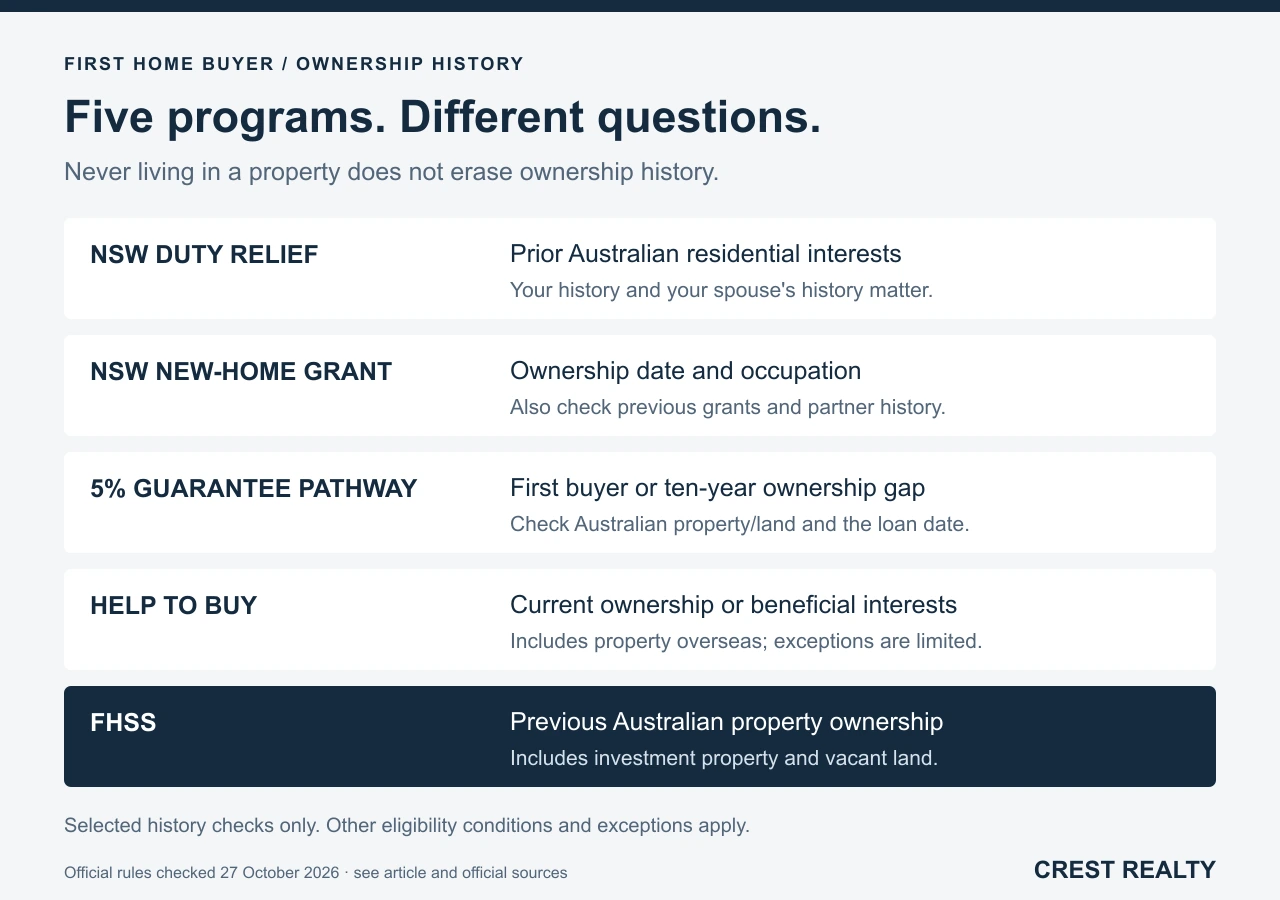
1. Five different ownership questions
| Program | Main ownership-history question to investigate |
|---|---|
| NSW First Home Buyers Assistance Scheme — duty relief | Have you or your spouse previously held a relevant Australian residential interest? |
| NSW First Home Owner Grant — qualifying new homes | When was Australian residential property owned, was it occupied, and was a grant received? |
| 5% Deposit Scheme — first-home pathway | Are you a first buyer, or have you been without Australian property or land for at least ten years? |
| Help to Buy | Do you currently own or beneficially own property in Australia or overseas? |
| First Home Super Saver — FHSS | Have you ever owned Australian property, including vacant land or an investment property? |
These are prompts for checking, not yes/no approvals. Sources and important exceptions are explained below. For the wider comparison of assistance and costs, use our NSW first-home buyer assistance overview.
2. NSW: stamp-duty relief and the new-home grant can differ
First Home Buyers Assistance Scheme: occupation is not the ownership test
Revenue NSW requires you and your spouse or partner not to have previously owned or co-owned Australian residential property, or previously received the scheme's concession. A rental property can therefore matter even if it was never your home. Selling it does not create a general ten-year reset for this NSW duty scheme. Source: Revenue NSW duty-assistance rules.
A spouse's history can affect your eligibility even when they are not a party to the purchase contract. Revenue NSW's detailed guide also distinguishes relevant interests from property held solely as trustee or executor. Obtain advice about the actual interest and relationship rather than treating every title entry alike. Source: detailed purchaser eligibility guide.
First Home Owner Grant: the date and occupation history matter
Revenue NSW says an Australian residential investment interest acquired on or after 1 July 2000 may not prevent a grant on another property. But its form excludes applicants and spouses/partners who owned a relevant residential interest before 1 July 2000, even if they never lived there. For interests acquired on or after that date, occupation for six continuous months or more is a disqualifying test. Previous grants must also be disclosed; returned grants need specific assessment.
Sources: Revenue NSW new-home grant and the OFH002 application and lodgement guide. The grant still requires an eligible new-home transaction, value limits and residence conditions. Do not infer approval merely from never occupying a rental property.
3. Federal programs ask different questions again
5% Deposit Scheme: the first-home pathway includes a first buyer or someone who has not owned Australian property or land in the previous ten years. The official FAQ measures that period from the previous property's sale to entering the new loan agreement—not simply to starting a property search. Both joint applicants must meet the criteria. This article covers that first-home pathway; separate single-parent/legal-guardian provisions exist. Sources: first-home eligibility and official FAQ. See our 5% deposit and 95% loan guide for funding considerations.
Help to Buy: former ownership is not the same as current ownership. The current test generally prevents owning or beneficially owning property in Australia or overseas, with limited single-parent exceptions. Returning owners may be considered, but citizenship, income, financial capacity and other requirements remain. Source: Help to Buy eligibility. Our Help to Buy comparison explains shared equity and ongoing obligations; it is not interchangeable with the guarantee.
FHSS: the ATO generally requires no previous Australian property ownership, including investment property, vacant land, commercial property and certain other interests. An inherited share on title can count. There is a specific financial-hardship route, not a general reset after selling or waiting ten years. FHSS eligibility is assessed individually. Source: ATO FHSS eligibility. Read our FHSS deposit-saving guide before planning contributions or release.
4. Spouses and joint buyers need separate attention
Do not carry one program's treatment of partners across to every other program:
- NSW duty relief: a spouse's previous ownership can disqualify the buyer even without the spouse on the contract. Special arrangements with an ineligible equity partner have conditions and do not remove the spouse rule. See Revenue NSW's equity-partner guidance.
- NSW new-home grant: each relevant applicant and their spouse/partner's history needs checking under the grant's rules.
- 5% guarantee and Help to Buy: joint applicants must each satisfy their scheme's criteria; the relevant ownership tests differ.
- FHSS: an eligible person's co-buyer having owned before does not automatically prevent that eligible person from using their own FHSS amount.
Use the sources above to check your actual circumstances. A separation, inherited interest, trust or overseas holding deserves disclosure and clarification, not an assumption based on whose name appears on the next contract.
5. Three hypothetical situations
These examples isolate ownership history. Assume no undisclosed interests, no previous assistance, and no applicable exception unless stated. All remaining eligibility, property and finance conditions still need assessment.
A rental unit owned from 2018 to 2022, never occupied: that history generally prevents NSW first-home duty relief and FHSS. It may still permit consideration for the NSW new-home grant. By October 2026, a 2022 sale has not met the guarantee pathway's ten-year ownership gap.
A former home sold in September 2014, with no ownership since: by October 2026, the ten-year test may be met for a new guaranteed loan. That does not restore eligibility for NSW duty relief or FHSS. Help to Buy's current-holdings test is a separate check; it does not automatically approve the applicant.
One partner has owned before, the other never has: the first-time buyer should not assume NSW duty relief merely by buying in their own name. FHSS can produce a different result because eligibility is individual. Ask the relevant adviser or agency to check both people against each program.
6. Prepare an ownership timeline before finalising your budget
Before relying on assistance, list:
- every Australian and overseas interest, including shares, inherited interests and land;
- acquisition, registration, sale and transfer dates;
- whether and when you occupied a property, with exact periods;
- spouse/partner and co-buyers' relevant histories;
- prior grants, concessions, FHSS releases and any repayments or agency decisions.
Ask your conveyancer, lender or administering agency which evidence they need and how to provide it. Confirm which benefit is being assessed and whether any exception needs a formal decision.
Keep unconfirmed benefits separate in your budget. Our NSW buying-costs calculator can help organise assumptions, but cannot verify your ownership history or an agency's decision.
Once your buying parameters are clearer, explore buying with Crest Realty or land and house-and-land project information. Contact our team about your property search with your preferred area, budget and property needs; finance, tax and legal eligibility remain matters for the relevant professionals and agencies.
General information only, not personal legal, tax, credit, superannuation or financial advice. Rules and definitions can change. Confirm the current program rules and your exact interests, relationships and transaction before committing.