
“How much could my property rent for?” is a natural first question for a landlord. The more useful follow-up is: what evidence supports that figure?
A rental appraisal should help you make a leasing decision, not simply give you the highest number to put into a spreadsheet. A strong estimate connects your property’s features with comparable rental evidence and explains the assumptions behind the recommended price.
For Sydney investors, the goal is not just an attractive weekly rent. It is a realistic plan for rental income, vacancy and the costs of holding the property.
1. Start with comparable homes, not a Sydney-wide average
Two homes in the same suburb can compete for different renters. Before relying on a comparison, look beyond bedroom count to the dwelling type, layout, bathrooms, parking, condition and usable outdoor space. Street location, access to transport and nearby amenities may also matter.
A new four-bedroom house is not automatically comparable with every other four-bedroom listing nearby. A compact floor plan, an additional living area or a different parking arrangement may change how useful the comparison is.
Ask the person preparing your appraisal:
- Which properties are the closest matches, and why?
- When was each rental figure recorded?
- What important differences have been allowed for?
If the evidence comes from a neighbouring suburb or an older letting, the appraisal should explain why it remains relevant rather than treating it as an exact match.
2. Separate asking rent from confirmed leasing evidence
An advertised price tells you what an owner is asking. By itself, it does not establish the rent ultimately agreed or how long the property will take to let.
Ask whether each comparable is currently advertised, marked as leased, or supported by a confirmed rental result. A “leased” label without an agreed rent should not be presented as proof that the original asking price was achieved.
Government data can provide a useful cross-check. NSW Fair Trading’s Rent Check uses recent rental bond information to show a median range by postcode, property type and bedroom count. It is a guide, not a valuation of your home.
A postcode can cover more than one suburb. Treat that broader benchmark as context alongside property-specific evidence, not a reason to ignore the condition or features of the actual home.
3. Understand what an appraisal range means
An estimate may include a range to reflect uncertainty about presentation, availability or the strength of the comparable evidence. Ask what would support the upper end, what assumptions underpin the lower end, and whether an inspection is needed before recommending an asking price.
That assessment range is different from a public rental advertisement. NSW residential rental advertising generally requires a fixed rent, not a range or “offers from” wording; landlords and agents must not solicit offers above the advertised amount. See NSW Fair Trading’s advertising and rent-bidding guidance, including its exception for signs on or near the property.
The practical question is: what single advertised rent does the evidence support now, and what feedback would justify reviewing it?
4. Compare annual income, not just weekly rent
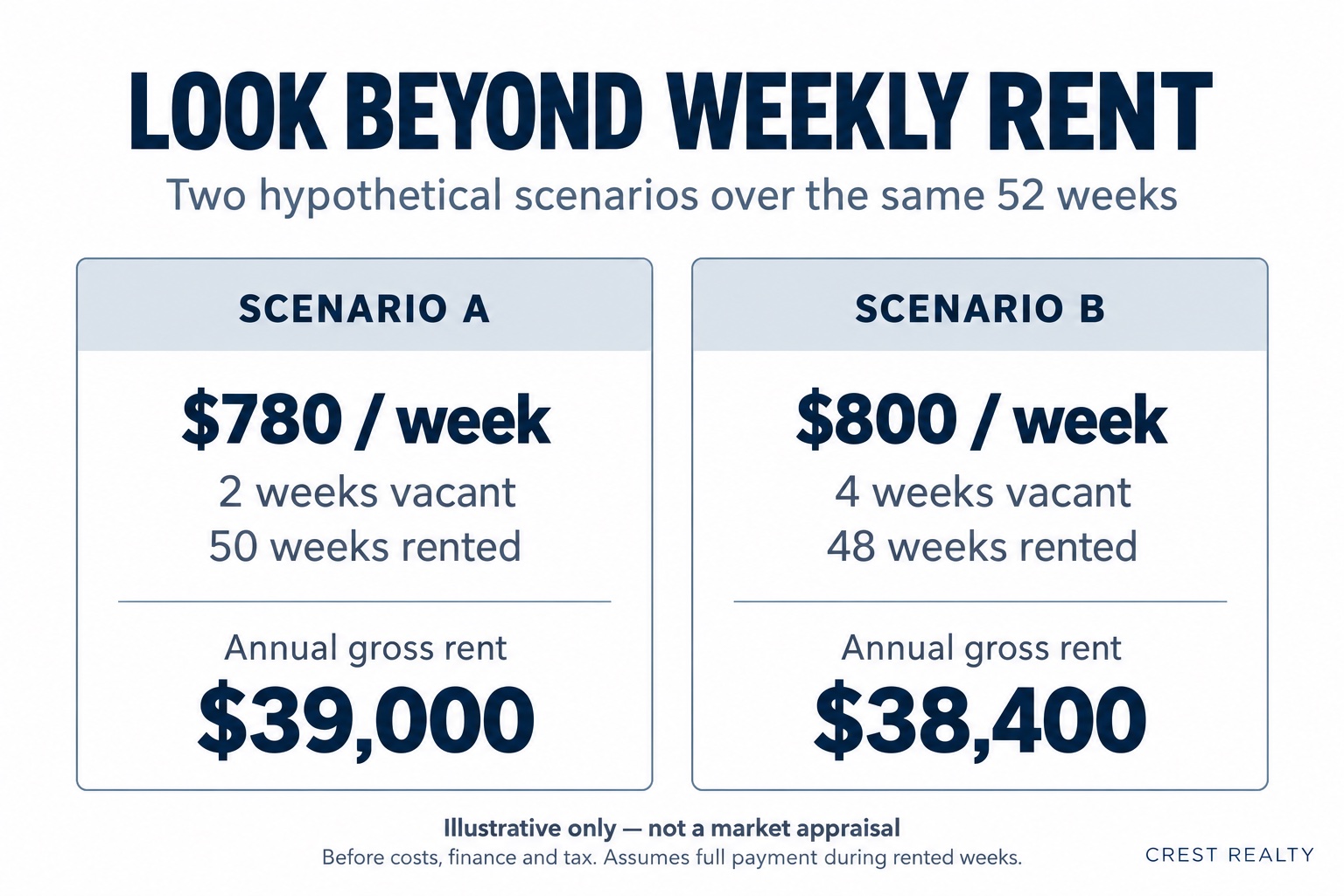
A higher weekly figure does not necessarily produce more income if the property remains vacant for longer.
Consider these two hypothetical scenarios for the same 52-week period:
| Assumption | Scenario A | Scenario B |
|---|---|---|
| Weekly rent | $780 | $800 |
| Weeks vacant | 2 | 4 |
| Weeks of rent collected | 50 | 48 |
| Gross rent collected | $39,000 | $38,400 |
In this illustration, Scenario A collects $600 more despite its lower weekly rent. The figures are illustrative assumptions only: they are not Sydney market rents, a Crest case study, or a prediction that a particular price will cause a particular vacancy period.
Both scenarios assume full payment during occupied weeks and exclude fees, repairs, incentives, finance and tax. They do not prove that choosing a lower rent is always better. They show why vacancy assumptions deserve as much attention as the headline price.
5. Keep collected rent separate from spendable income
A rental appraisal is not a complete investment cash-flow assessment.
Depending on the property, outgoings can include management and letting fees, advertising, council rates, owner-payable water charges, insurance, strata levies, maintenance and applicable land tax. Finance payments add a separate cash commitment. ASIC’s Moneysmart property-investment guide highlights both ownership costs and the risk of periods without rental income.
For planning, start with expected rent actually collected, allow for the property’s outgoings, and then assess finance payments and tax separately with the appropriate adviser. Gross rent, cash flow and taxable income are different measures. Do not assume that every cash payment is tax-deductible.
When comparing management proposals, read the full schedule of inclusions and charges rather than only the management percentage. Our Property Management page includes a fee-comparison checklist.
6. Agree on a review process, not a guaranteed outcome
Before a vacant property is advertised, discuss how the campaign will be reviewed. Useful questions include:
- What preparation or repairs are needed before advertising?
- How will enquiries, inspection attendance and applicant feedback be assessed?
- If interest is weak, how will price, presentation, availability and competing listings be considered together?
- When will the next review occur, and who approves any change?
Agree the review arrangements with your manager rather than assuming that every proposal includes the same service. Neither a higher estimate nor an online appraisal is a guarantee of a tenant, an agreed rent or uninterrupted income.
If the property is already tenanted, a new appraisal does not automatically permit a rent increase. Timing, notice and agreement requirements still apply. Check the current NSW rent-increase rules before taking action; do not treat a lease renewal or a change of manager as permission to reset the rent immediately.
Discuss a rental appraisal with Crest Realty
Whether you are preparing to lease an investment property or reviewing an existing management arrangement, start with a clear brief: the suburb, property type, bedroom and bathroom count, parking, condition, occupancy and intended timing.
Contact Crest Realty to discuss your property and the next steps for a rental appraisal. If you are considering a management change, our NSW switching guide explains the handover questions to work through.
Please do not send tenant details, identity documents, bank statements or tenancy agreements through the public enquiry form.
The best starting point is an estimate you can understand and test—not simply the largest number on the page.
General information only, checked against the linked official sources on 18 October 2026. This article is not a property-specific rental valuation, guarantee, or legal, financial or taxation advice. Rules and market conditions can change; obtain advice appropriate to your property and circumstances.