
The end of a fixed-term lease is a useful moment to review an investment property—but it is not simply a date to send out another agreement.
Before deciding what comes next, a landlord should consider the property’s condition, the tenant’s plans, rental evidence and their own intentions for the investment. A decision to renew, continue the tenancy or prepare for a sale can have different practical and legal consequences.
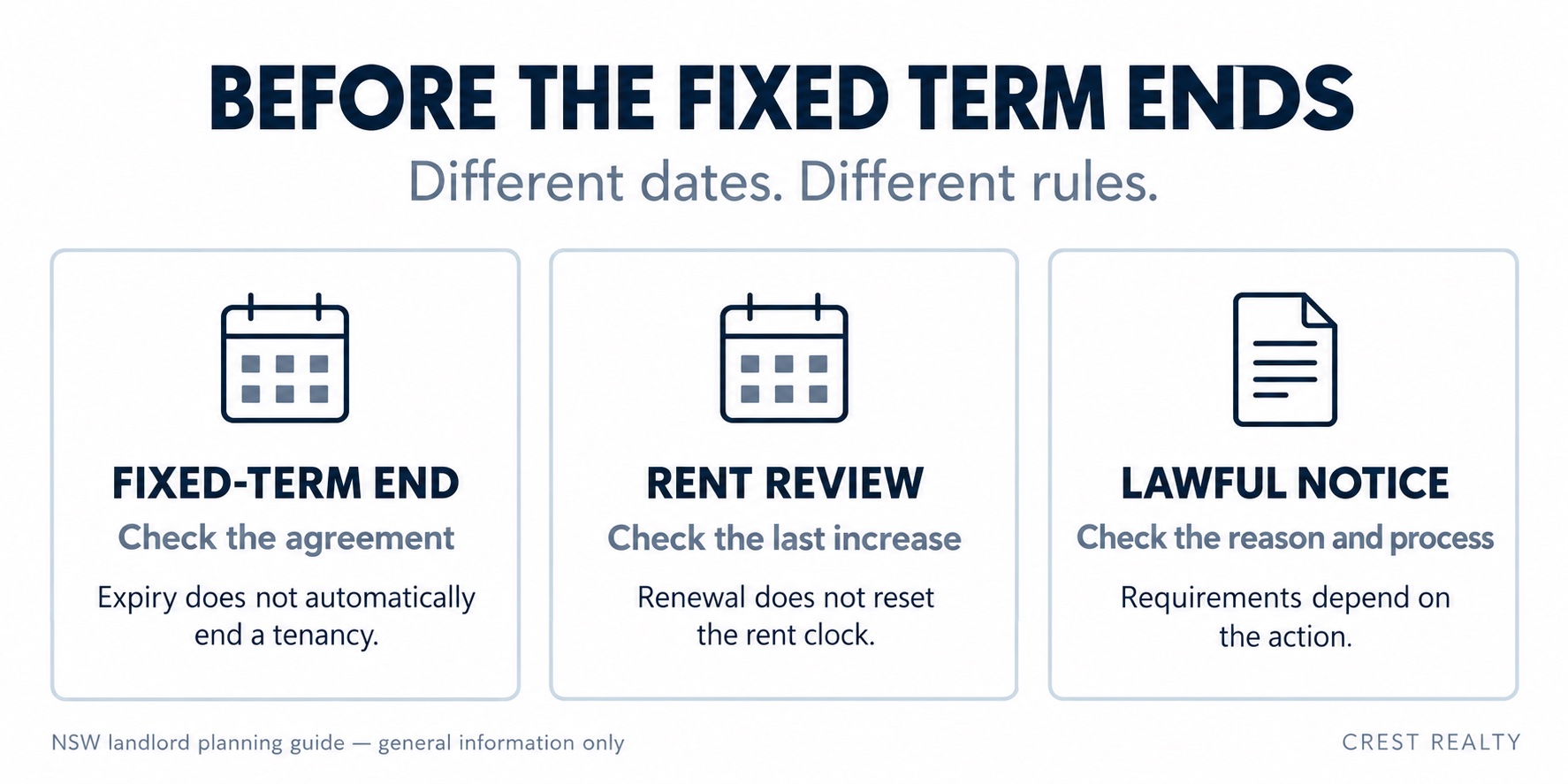
The starting point is to separate three things that are often confused: the fixed-term end date, the timing of any rent increase, and the process for lawfully ending a tenancy. They do not automatically fall on the same day.
1. Understand what the fixed-term end date actually means
In NSW, if a fixed-term agreement ends and no new agreement is signed, the tenancy generally continues as a periodic agreement unless it has lawfully ended. A periodic agreement has no specified end date. See NSW Fair Trading’s tenancy-agreement guidance.
That means “we are not offering another fixed term” should not be treated as an instruction that the tenant must leave when the existing term expires. Landlords need a lawful ground and the correct process to end a tenancy, including at the end of a fixed term. NSW guidance on landlord termination explains the current requirements.
Start by confirming the signed agreement, its dates and any existing notices with your property manager. Do not plan new advertising, a handover of vacant possession or contractor access on the assumption that the home will automatically be empty.
2. Decide what you want from the next stage of ownership
Before discussing a new agreement, clarify your own plans. Are you intending to keep the property as a rental, considering a sale, or investigating work that could affect its use?
If you intend to keep renting it, discuss whether a further fixed term or periodic continuation suits both parties’ plans. A new fixed term creates commitments; a periodic arrangement does not remove tenant protections or give the owner unrestricted access to the property.
Useful questions include:
- Has the tenant indicated whether they would like to stay?
- Is your own plan settled, or are you still exploring options?
- Are there property issues that need attention regardless of renewal?
- What would a change of tenant involve in vacancy, preparation and letting costs?
The objective is an informed decision, not a renewal or a tenant change simply because a date has arrived.
3. Keep the rent review on its own calendar
A lease renewal is not an automatic opportunity to reset the rent.
Under the standard NSW rules, rent cannot increase during the first 12 months of the agreement, and at least 12 months must pass between increases. Renewing or replacing the agreement does not restart that clock where the same landlord and at least one continuing tenant remain and the tenant has not moved out. Written rent-increase notice is generally required at least 60 days before the increase takes effect. Some older fixed-term agreements have different rules; confirm the agreement, applicable exceptions and lawful service with your manager before acting. Read the current NSW rent-increase rules.
Keep these separate dates in your review:
| Date to confirm | Question it answers |
|---|---|
| End of the current fixed term | When does the agreed fixed period finish? |
| Tenancy start and last effective rent increase | When could another increase lawfully take effect? |
| Any required notice and service dates | What process and lead time apply to the proposed action? |
If a rent review is appropriate, ask for current evidence rather than an automatic percentage increase. Our Sydney rental-appraisal guide explains how to compare rental evidence and look beyond the weekly figure.
An appraisal supports a pricing discussion. It does not override the tenancy agreement or the law.
4. Review the tenancy using records, not assumptions
Ask for a factual summary of rent payments, outstanding matters, reported maintenance and the most recent lawful inspection. Distinguish unresolved property repairs from issues that require a separate tenancy-management process.
A renewal discussion is also a chance to understand the tenant’s intentions and address practical questions early. Avoid assuming that a tenant wants to leave simply because they have not signed a new agreement, or that silence means agreement to changed terms.
Balance any proposed change against the costs and uncertainty of reletting. Look at the whole ownership plan rather than treating a higher advertised rent as the only measure of a better outcome. Handle any arrears, breach or dispute through the appropriate process, not an informal threat to withhold renewal.
5. Separate necessary repairs from optional improvements
Review unresolved repair requests and property-condition reports before focusing on cosmetic upgrades. Identify what needs attention now, what requires further assessment, and what is an optional improvement to budget for later.
Landlords have ongoing obligations to keep the home in a reasonable state of repair. Urgent issues should not be left until renewal discussions are complete. The NSW repair and maintenance guidance explains those responsibilities.
If an inspection or trade visit is needed, arrange it through the applicable access and notice process. Ownership does not create an unrestricted right to enter. See the NSW entry and access rules.
Discuss scope, approvals and likely disruption with your manager before booking optional work. Do not assume that repainting or a minor upgrade requires the tenant to move out.
6. Coordinate any sale or major change before making promises
If selling is a possibility, involve your property manager, selling agent and solicitor or conveyancer before committing to a campaign or settlement timetable. Discuss whether a proposed sale would be subject to the tenancy or require vacant possession, and what is lawfully achievable.
Sale-related termination grounds have specific conditions, documents and notice requirements. Notice depends on the ground and agreement; some grounds also carry re-letting restrictions. A possible sale, renovation or wish to move in should not be used as a convenient label for a different intention. Check the current NSW termination requirements and obtain advice on the actual circumstances.
Do not promise a vacant home merely because the fixed term is nearly over. Equally, avoid signing a further fixed term without understanding how it fits your genuine plans. Discuss marketing options through our selling services, with the tenancy position considered from the outset.
7. Finish the review with a clear action list
Ask your manager to turn the discussion into a short written plan:
- the current agreement and key dates;
- the tenant’s stated intentions, if known;
- your preferred next step and any decision still awaiting advice;
- the evidence and lawful timing for any proposed rent change;
- repairs, access arrangements, approvals and budgets; and
- who will communicate with the tenant and record the agreed next steps.
Start early enough to obtain advice and meet the requirements that apply to your situation. There is no single “renewal deadline” that safely substitutes for checking the agreement and the proposed action.
Plan your next step with Crest Realty
For NSW landlords, good planning means connecting the tenancy decision with the property’s condition and your longer-term intentions—not treating renewal, rent and a possible sale as separate last-minute tasks.
Explore our property management services or contact Crest Realty to discuss your property, whether it is currently tenanted, your timing and the support you need.
Start with a brief description. Please do not upload tenant details, identity documents, banking information or a full tenancy agreement through the public website form.
Use the fixed-term end date as a prompt to plan—not as an assumption that the tenancy, rent or tenant’s rights automatically change.
General information for NSW residential landlords, checked against the linked official sources on 19 October 2026. This is a planning guide, not a notice, legal opinion or advice to end a particular tenancy. Rules, exceptions and circumstances can change. Confirm the requirements with your property manager and obtain independent legal advice before serving notices or committing to vacant possession. No rental, leasing or sale outcome is guaranteed.