
When you decide to sell, it is easy to start seeing your home as a long list of jobs: paint the walls, replace the kitchen, fix the garden, buy new furniture. But a sale-preparation plan is not the same thing as a renovation wish list.
The useful question is not “How can I make everything new?” It is “Which work will help buyers understand this property, which issues need proper attention, and which spending is difficult to justify before I sell?”
For a Sydney homeowner, the answer depends on the property's condition, likely buyers, competing listings, available budget and timing. There is no universal preparation allowance or guaranteed return on a renovation.
Here is a practical way to decide what to repair, refresh or leave alone before putting your home on the market.
1. Start with the buyer and the property, not the shopping list
Before booking trades or styling, ask your agent to walk through the home and explain its likely position in the market. Compare it with relevant properties in similar condition, not only the most polished listing in the suburb.
A relatively new family home with everyday wear, an older house needing substantial work and a compact apartment with limited storage present different questions. The same kitchen upgrade will not make equal sense for all three.
Useful questions for the appraisal discussion include:
- Which existing features should buyers notice first?
- What condition are comparable homes being offered in?
- Which visible issues distract from the home's useful space or layout?
- Is an item a genuine maintenance concern, a presentation issue or a matter of personal taste?
- What evidence supports a suggested improvement, rather than simply a preference for a particular style?
Your agent can discuss the market positioning; a qualified building professional should assess technical defects. An appraisal walk-through is not a building inspection or confirmation that the property is compliant.
For the wider journey from appraisal to settlement, see our step-by-step guide to selling property in Sydney. This article focuses on the work before listing.
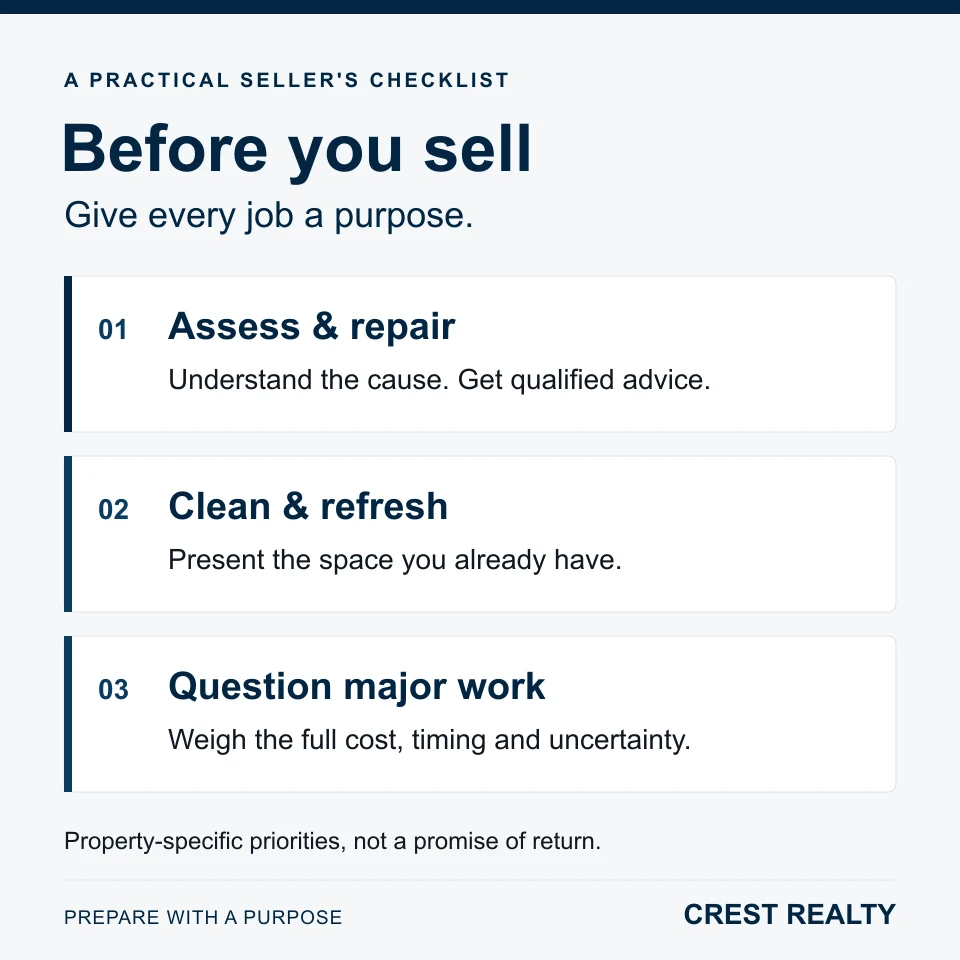
2. Sort the work into three groups
Use three categories to turn an open-ended list into a set of decisions.
| Category | What belongs here? | A useful next step |
|---|---|---|
| Assess and repair | Safety concerns, active leaks, unexplained damage or faults affecting everyday use | Establish the cause and appropriate scope with a qualified professional |
| Clean and refresh | Cleaning, decluttering, furniture arrangement, garden tidying and selected cosmetic work | Choose the smallest practical change that improves presentation |
| Question major work | A new kitchen, bathroom, extension or substantial landscaping undertaken mainly to sell | Compare the full cost, timing and uncertainty with selling in the current condition |
These are planning categories, not a finding that every repair must be completed before a sale. Significant issues need assessment and an honest sale strategy; the right response may require legal or technical advice. A cosmetic treatment is not a substitute for resolving or appropriately disclosing an underlying problem.
3. Investigate problems before spending on appearance
Repeated staining, persistent damp, movement, damaged wiring or a recurring leak should not be treated as a decorating task on sight. Ask a suitably qualified professional what is happening before deciding whether repainting or replacing a finish makes sense. Do not attempt electrical or other hazardous work yourself.
For smaller jobs, define the outcome clearly: does the door need adjustment, repair or replacement? Is a fitting faulty, or simply dated? A precise scope helps you compare written quotations and avoid paying for a broader change than you intended.
Check qualifications and the appropriate licence for the work. NSW Government guidance on choosing a qualified contractor or tradesperson explains that specialist work requires licensing regardless of its cost. Do not assume that a low price makes a job suitable for an unlicensed person.
If work could disturb suspect older materials, stop and obtain specialist advice. NSW Planning's asbestos guidance recommends professional risk assessment before renovating an older home. This is not a DIY removal guide.
Keep the relevant scopes, invoices, reports and any applicable approvals together. They help you explain what was done; an invoice by itself is not proof that every related issue has been resolved.
4. Refresh what buyers need to see and use
Presentation work should make the existing home easier to understand, rather than imply that it is a different property.
Start with ordinary tasks: clean the surfaces and windows, remove unnecessary items from benches, organise storage and make the entrance accessible. Arrange furniture so people can move through the rooms and recognise their intended use. A study does not need to be restyled as an extra bedroom to look useful.
Outside, a tidy path, maintained garden and clearly visible entry may be enough to present the space coherently. A complete garden redesign is a separate investment decision, not a default requirement.
Then consider selective cosmetic work. A worn area of paint or flooring may deserve attention, but assess its condition, the reason for the damage and whether a limited repair will blend acceptably. Check the preparation and finishing scope before accepting a quotation.
Styling is also optional. Compare using your own furniture, a partial styling service and a more extensive package. Include hire duration, delivery, removal, storage and extension charges in the comparison. None of these choices guarantees a higher selling price.
5. Make a major renovation justify itself
A new kitchen or bathroom can change the product you are offering. It also introduces decisions about design, trades, approvals, disruption and the risk of uncovering additional work.
Before committing, compare two realistic options: selling after limited preparation, and selling after the proposed renovation. Ask what evidence supports the second option and what uncertainty remains.
Include more than the headline quotation. Consider related professional or approval costs, disposal, storage or temporary accommodation where relevant, the cost of holding the property for longer and a separate allowance for uncertainty. Avoid assuming a specific selling date when testing affordability.
The key comparison is the possible additional sale proceeds against all additional costs and risks, not the renovation cost against an optimistic advertised price. Ask your agent for evidence and your financial or tax adviser about your circumstances. A higher gross selling price would not, by itself, prove a better net outcome.
Sometimes the practical choice is to sell an older but functional room in its current condition and describe it accurately. Sometimes assessed repair work is the priority. Do not treat this framework as a recommendation to leave a safety issue unattended or conceal a defect.
6. Prepare the information alongside the house
A completed garden does not make a property ready to advertise if the legal preparation is unfinished. The NSW Government's selling steps state that the contract must be prepared before advertising. Engage your solicitor or licensed conveyancer early and ask what documents your property requires, including any relevant renovation, strata or pool information.
Tell the agent and your legal adviser about known issues, previous work and uncertainties. Ask what needs investigation, documentation or disclosure; do not decide that a coat of paint removes the need for that conversation.
NSW Fair Trading's misrepresentation guidance for property agents covers misleading statements, misleading omissions and the disclosure of prescribed material facts. Marketing should accurately represent the property, not create a false impression about its condition or features.
Review photographs, floor plans and descriptions with that principle in mind. Presentation can show a home clearly; it should not disguise problems or imply that an unfinished improvement is already complete.
7. Put the preparation plan in writing
Before committing to a photography or launch date, make one shared work list. For each item record the scope, responsible person, written cost, dependency, target completion date and evidence needed to confirm completion. Keep unresolved costs visible instead of entering zero.
Use this final checklist:
- Have technical or safety concerns been assessed by the appropriate person?
- Are essential repairs separated from optional presentation choices?
- Are quotations clear about inclusions, exclusions and applicable GST?
- Have required licences, permissions and approvals been checked for the work?
- Does the budget include related costs and uncertainty, not just one quote?
- Are the contract preparation and property-information tasks progressing?
- Can the photography and inspection plan describe the property accurately?
- Is there a fallback if work takes longer or costs more than expected?
If the home is occupied, make the plan workable for daily life. If it is rented, ask your property manager for a separate access and preparation plan that takes the tenancy into account; this article does not set out tenancy access rules.
Discuss a practical sale-preparation plan with Crest Realty
You do not need to finish a renovation before asking for an appraisal. An early conversation can help you discuss the likely buyer, market evidence and the questions to resolve before you commit to optional work.
Explore selling with Crest Realty or request an appraisal discussion with the suburb, property type, current occupancy, preferred timing and a brief description of the work you are considering. Do not send identity documents, bank statements or contracts through the public enquiry form.
Prepare with a purpose: investigate what matters, present what is there and question spending that has no clear role in the sale.
General information only. Official sources checked on 20 October 2026. This article is not a building inspection, compliance assessment, valuation, or legal, financial or taxation advice. Costs and outcomes depend on the property and circumstances; no sale price, sale date or renovation return is promised. Obtain appropriate independent advice before committing to work or a property transaction.