
Policy information checked 26 October 2026.
NSW first home buyer assistance can reduce the cost of buying, but there is no
single benefit that every first-time buyer receives. Stamp duty relief reduces
a tax bill; a new-home grant provides money for an eligible transaction; a
government guarantee supports an eligible home loan.
Work out which rules apply to you, your co-buyer and the particular property
before putting any benefit into your budget. Approval for one program is not
approval for all three.
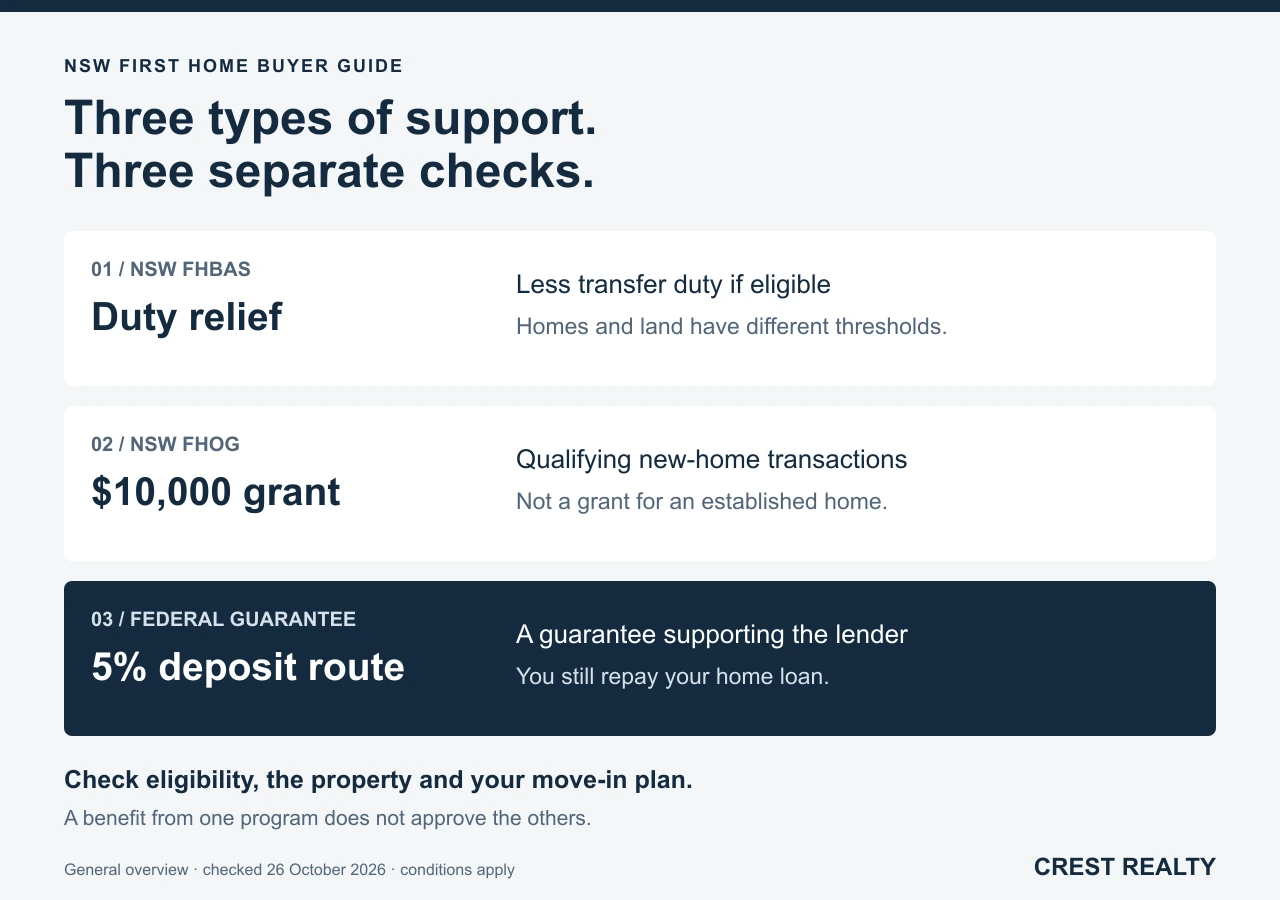
Compare the three main types of support
On a small screen, scroll the comparison tables sideways to see all columns.
| Program | What it helps with | Property filter to check |
|---|---|---|
| NSW First Home Buyers Assistance Scheme (FHBAS) | Exempts or reduces transfer duty, commonly called stamp duty. It is not a cash deposit. | New or existing homes, or vacant land intended for a home, within the relevant value thresholds. |
| NSW First Home Owner (New Homes) Grant (FHOG) | A $10,000 grant for qualifying new-home transactions. | Qualifying new-home purchase up to $600,000; eligible land plus a comprehensive building contract up to $750,000, including variations. Established homes do not qualify. |
| Australian Government 5% Deposit Scheme | A lender guarantee allowing eligible first home buyers to purchase with a minimum 5% contribution and no Lenders Mortgage Insurance (LMI) on an eligible loan. | Eligible owner-occupied property within the location cap, with lender approval. It does not pay off any of your loan. |
The NSW duty scheme,
new-home grant
and Australian Government guarantee
are separate programs. Their similar first-home language should not hide their
different purposes.
The price limits are different — and the boundaries matter
For FHBAS contracts exchanged on or after 1 July 2023, eligible homes valued at
$800,000 or less can receive a full duty exemption. Above $800,000 and below
$1 million, a concession may apply. At $1 million, that home concession does not
apply. For eligible vacant land, the corresponding limits are $350,000 or less
for exemption, and above $350,000 but below $450,000 for a concession.
Check Revenue NSW's current thresholds
against the value and contract date of your transaction.
The grant has a different test. A new-home purchase and a land-plus-building
transaction do not share the same cap. Building variations count towards the
grant's combined limit; a property being advertised as “new” or “house-and-land”
does not establish eligibility. Check the transaction against
Revenue NSW's grant rules.
For the federal guarantee, the current property-price cap table
shows $1.5 million for Sydney and specified NSW regional centres, and $800,000
for other NSW areas. Confirm the suburb and postcode with the participating
lender. Both purchase price and assessed value must meet the cap; separate
land and building contracts must meet the combined-cost test.
A home can be below the guarantee cap but above the grant or duty thresholds.
Nor is any scheme cap a statement of your borrowing capacity.
Who qualifies? Check the people as well as the property
The FHBAS eligibility guide
requires checks on the eligible purchaser and their spouse's residential
ownership and previous assistance history. Eligible purchasers generally need
to be individuals aged 18 or older; at least one first home buyer must be an
Australian citizen or permanent resident. Previous Australian residential
ownership or a previous FHBAS exemption/concession can disqualify you, including
through your spouse's history. Buying with a spouse who is
ineligible differs from buying with another ineligible equity partner; ask
your conveyancer to assess the actual ownership shares and relationships.
For FHOG, Revenue NSW's application guide
checks applicants and their spouse/partner, previous grants, and property
history. Applicants generally must be at least 18, with at least one Australian
citizen or permanent resident. Prior Australian residential ownership before
1 July 2000, or living for six continuous months in an owned Australian home
acquired on or after that date, can exclude you. Do not assume an old investment
property has the same effect under every program; have the complete history
assessed under the grant's rules.
Under the federal first home buyer pathway,
applicants must be adults and Australian citizens or permanent residents. It
can cover first-time buyers and some people who have not owned Australian
property or land in the previous ten years. Both applicants must qualify when
applying jointly, and the participating lender must approve the loan.
Those differences are why “the bank said I qualify” cannot replace a separate
NSW benefits assessment. Give each adviser the complete ownership and
relationship history, including partial interests; resolve uncertainties
before relying on the expected saving.
Self-occupation: three programs, different clocks
These are home-ownership pathways with residence conditions, not a general
subsidy for buying a rental investment. For current transactions, the ordinary
requirements include:
| Program | When occupation starts | How long it continues |
|---|---|---|
| FHBAS: new or existing home, current contract rules | Within 12 months after settlement. | At least one eligible buyer occupies it as their principal home for 12 continuous months. |
| FHOG: current contract rules | Within 12 months of completion of the eligible purchase or construction. | At least one applicant occupies it as their principal home for 12 continuous months. |
| 5% Deposit Scheme | Within six months of loan settlement, or the occupancy certificate for a new build. | Owner-occupation continues while the guarantee supports the loan. |
Sources: FHBAS residence guidance,
FHOG application guidance
and the federal Information Guide.
Vacant-land and construction transactions, exemptions and exceptional
circumstances need specific confirmation. An exemption under one program does
not waive another program's conditions.
If combining support, plan to satisfy every applicable condition, not just
the easiest move-in deadline. Existing tenants and delayed construction can
affect that plan. Contact the relevant agency or lender promptly if your
circumstances change; benefits or guarantee coverage may be lost.
Can the benefits be combined?
Potentially, provided each program's rules are met. Revenue NSW's grant guidance
allows an eligible grant alongside other exemptions or concessions. Section 5.5 of the
federal Information Guide
also explains that the guarantee does not prevent access to other government
housing support, subject to those programs' requirements.
That is permission to check a combination, not a promise of three benefits.
Ask the lender how an approved grant would be treated in your funding and
when it would actually be available. Do not subtract a hoped-for grant from
the cash needed to exchange contracts.
Help to Buy is different. It involves government shared equity rather than
this lender guarantee. The two federal schemes cannot be used together.
Help to Buy's official guidance
allows qualifying grants and duty concessions, but its own eligibility,
ongoing reviews and shared-value arrangements still apply. It is not an
extra guarantee to add to a 95% loan.
A hypothetical budget: an established $700,000 home
Assume a genuinely eligible owner-occupier, an established home priced and
valued at $700,000, and a lender approving the assumed loan:
- A 5% purchase contribution is $35,000, leaving $665,000 in purchase funding
from the loan. The guarantee does not reduce that debt. - If the buyer meets all FHBAS conditions, transfer duty can be exempt.
- The new-home grant is not available for this established home. Do not put
$10,000 into this purchase budget as an expected grant.
This illustrates the distinction between the programs; it is not a property
offer, eligibility decision or complete funds-to-settle calculation. Legal
work, inspections, lender/settlement charges, adjustments, moving expenses and
a cash buffer remain additional. Any surcharge purchaser duty also needs a
separate check where relevant.
Use our buying costs and cash needed calculator
as a starting worksheet, then reconcile the numbers with your conveyancer and
lender. Compare the loan's ongoing cost with the mortgage repayment calculator.
Neither calculator approves finance or benefits. For the funding mechanics,
read our 5% deposit and 95% loan explainer.
When to apply: build the checks into your buying timeline
- Before committing: shortlist property types, prepare an ownership-history
summary and ask the lender and conveyancer to check the relevant programs.
Use the NSW Home Buyer Assistance Finder
for an initial indication, not a final approval. - As finance is assessed: arrange the guarantee through a participating
lender, not directly with Housing Australia. Scheme pre-approval is not
unconditional finance or a waiver of property checks. - After exchange: arrange FHBAS paperwork through your solicitor or
conveyancer. The Revenue NSW lodgement guide
covers the application, purchaser declaration and supporting evidence.
Have the duty and settlement deadlines confirmed for your transaction. - For a grant: if it is needed at settlement or a first progress payment,
apply through the approved agent providing finance. After completion, the
direct application route ordinarily requires lodgement within 12 months of
settlement or completed construction. Service NSW explains both routes.
Payment timing depends on transaction and application route; it is not
automatically cash available when the sale contract is signed. - After settlement or completion: keep the residence requirements and any
construction obligations in your calendar, retain evidence, and report
relevant changes to the agency or lender.
More guides for your buying decision
Use these guides to explore the question most relevant to your next step:
- Help to Buy or the 5% Deposit Scheme? — compare a lender guarantee with shared equity and future buyback obligations.
- House-and-land with a 5% deposit — check contracts, land registration, construction dates and cash payments.
- Saving a deposit through FHSS — understand eligible super contributions, release amounts and timing.
- Previous investment property and first-home eligibility — compare ownership-history and joint-buyer rules across programs.
Turn an assessed budget into a property shortlist
Once the lender and conveyancer have clarified your position, explore buying
with Crest Realty or review our land and house-and-land projects.
We can help you compare location, property type, timing and the details of
current opportunities. A package label alone does not prove policy eligibility.
Talk to Crest Realty about your first-home search, with the budget
and requirements you have already discussed with your advisers. Your lender
decides credit and guarantee approval; Revenue NSW and your legal adviser
address NSW benefits. No particular saving or approval is promised.
General information only, checked 26 October 2026. This is not personal credit,
financial, tax or legal advice. Rules, property values and lender policies can
change. Confirm current eligibility, deadlines, benefit amounts and payment
timing with the relevant agency, participating lender and your independent
advisers before entering a contract.