
Yes—eligible NSW buyers can use the Australian Government 5% Deposit Scheme for house-and-land or vacant land with a building contract. But a package advertised with a low deposit is not automatically eligible. The buyer, total cost, valuation, contracts and delivery dates all need to fit.
The Scheme provides a guarantee to the lender, helping eligible buyers avoid Lenders Mortgage Insurance (LMI). It does not pay your deposit, cover overruns or remove your repayment responsibility. Applications go through a participating lender. Source: Australian Government scheme overview.
Policy checked: 27 October 2026. This article focuses on the first-home-buyer 5% pathway. It is a preparation guide, not a finance approval or confirmation that any advertised project qualifies.
1. Check the complete purchase, not just the land price
For separate land and building contracts, the combined land price and build cost must meet the location cap. Both purchase price and lender-assessed property value must be within the cap. The current limit is $1.5 million in Sydney and specified NSW regional centres, and $800,000 in other NSW areas. Confirm the exact suburb/postcode with your lender. Source: official property price caps.
Take the lender a complete cost schedule, not only an advertisement. Useful questions include:
- Does the building quote include the site works required for this particular block?
- Which allowances, exclusions, approvals and connections remain to be priced?
- Are chosen upgrades in the signed price, or still optional additions?
- If the cost changes, what happens to the valuation, cash contribution and scheme assessment?
Our house-and-land quote comparison guide helps you organise inclusions and exclusions. An advertised figure is a starting point for checking documents, not a substitute for them.
2. Match the contract structure to the scheme pathway
For a house-and-land package, the Information Guide requires land and eligible building contracts before loan settlement. A separate land/build pathway permits the building contract within six months of home-loan settlement. Have your lender classify the actual arrangement before signing.
Eligible building contracts require a fixed price, licensed/registered builder, insurance and arm's-length terms; owner-builder contracts are excluded. Source: Information Guide, section 3.3.2.
Ask your solicitor or conveyancer to explain who sells the land, who builds, when each contract binds you, and what happens if finance or registration is delayed. Check whether one contract can continue if the other cannot proceed. The marketing label alone cannot answer those questions. Our house-and-land process guide explains the broader buying sequence.
NSW building contracts have their own consumer protections. For substantial work, check the written scope, plans, specifications, payment schedule, insurance and variation provisions. A fixed-price description still deserves a close review of allowances and permitted changes. Source: NSW Government building-contract guidance.
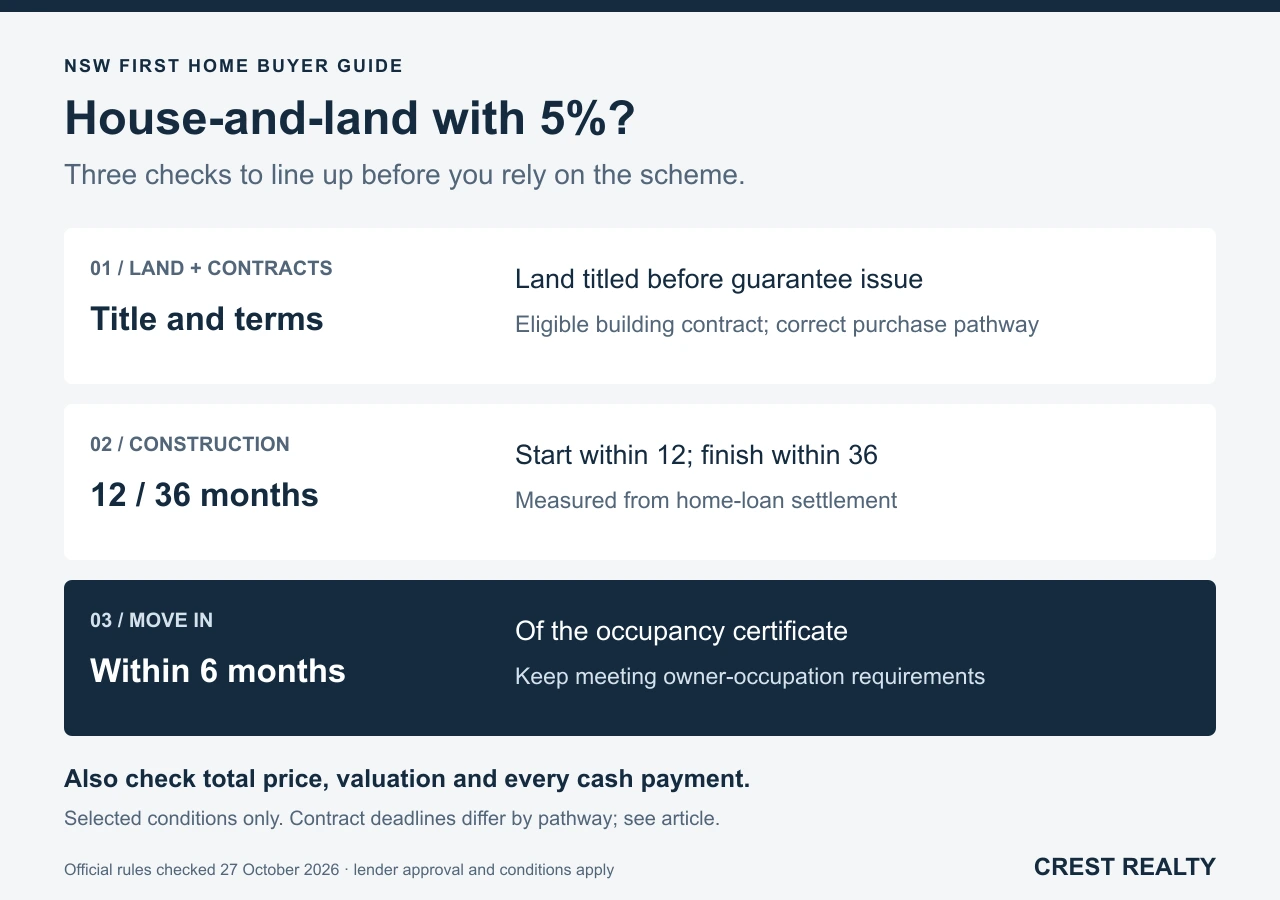
3. Check registration and the construction clock
| Milestone | Scheme requirement to confirm |
|---|---|
| Land title | Titled before guarantee issue, within the 90-day pre-approval period |
| Build commencement | Within 12 months of home-loan settlement |
| Build completion | Within 36 months of home-loan settlement |
| Move in | Within six months of the occupancy certificate |
Source: Information Guide, pages 12–13. If you already owned vacant land before securing a scheme place, a build-only loan on it is ineligible under that guide.
Ask the lender to write down the dates that apply to your transaction. A seller's estimated registration month, a builder's indicative start and a bank's finance conditions are different pieces of information. Resolve discrepancies before relying on them. Do not assume a long registration delay or construction extension will automatically be accepted.
Bring these questions to the discussion:
- Is the land registered, or is registration still expected? What evidence supports the date?
- Can approvals, site preparation and the builder's availability fit the required start?
- What contractual and funding options exist if a milestone is missed?
- Does the lender impose a tighter construction timetable or different documentation requirements?
4. A 5% loan deposit is not every upfront payment
The minimum deposit is linked to lender-assessed value, which can differ from the price. A larger saved deposit may need to be contributed. Source: official deposit FAQs.
Separately, your sale and building contracts set payment obligations. NSW's maximum home-building deposit is 10% of the building contract price; that does not mean every builder asks for 10%, or that the loan scheme reduces a contractual payment to 5%. Where Home Building Compensation cover is required, check the certificate before paying. Source: NSW contract and deposit rules.
Have your adviser map how much cash is due, to whom, and on which date, including whether the lender funds that payment. A finance contribution and a contract deposit can form part of the same purchase funding—do not simply add every quoted “deposit” together or assume one automatically covers another.
Hypothetical example: equal price and valuation
Assume approved finance for an eligible land-and-build transaction, with all land/build costs used in this illustration included in the prices below:
| Item | Illustrative amount |
|---|---|
| Land | $610,000 |
| Build | $360,000 |
| Combined price and assumed completed value | $970,000 |
| 5% buyer contribution | $48,500 |
| 95% purchase funding from loan | $921,500 |
This is arithmetic, not a quote, available package or commitment to lend. Duty, legal costs, inspections, finance fees, moving costs and a cash buffer remain additional unless separately allowed for. The timing of your cash payments still needs checking.
What if the valuation is lower? If accepted value were $940,000 and the lender advanced 95% of that value, the loan would be $893,000. Against the same $970,000 purchase cost, the buyer would need $77,000, before other costs—$28,500 more than the equal-value illustration. Actual lending terms may differ.
Explore assumptions with our buying-costs calculator and mortgage repayment calculator. Confirm duty treatment and any concessions with your conveyancer; the NSW first-home assistance overview explains why a loan guarantee and state concessions are separate assessments.
5. Plan cash flow during the build
Construction funding commonly involves progress payments for completed stages. Check how invoices, your authorisation and lender release fit the building contract, and when repayments begin. The NSW Planning Portal build guide explains progressive payments and the need to confirm your repayment schedule with the lender.
Prepare a monthly budget that includes current accommodation, payments on drawn funds, insurance, relevant holding costs and a contingency. Ask what a delay would do to that budget. Do not treat a bank's progress inspection as your own comprehensive quality inspection; consider independent advice on building checks.
Pre-approval is also conditional. The lender still assesses the property and your financial circumstances before final approval. Source: ASIC Moneysmart's buying guide. Ask whether your income, debts or selected plans have changed since the initial assessment.
Before choosing a package, get the documents together
A useful starting pack is the land contract and title/registration information, proposed building contract, plans and inclusions, complete cost schedule, timeline and your cash-flow questions. Let your lender assess funding and scheme eligibility, and your legal adviser review the obligations.
For the wider loan rules, see our 5% deposit and 95% loan guide. Crest Realty can help you compare land and house-and-land project information against your confirmed search budget, preferred location and home requirements.
Contact Crest Realty about your property search. We can discuss property options and available information; participating lenders and your advisers confirm finance, scheme conditions and legal suitability.
General information only, not personal credit, legal or financial advice. Rules and lender policies can change. Verify current conditions and the exact property, contracts and dates before committing.