
Help to Buy can reduce the bank loan needed by contributing government equity. The 5% Deposit Scheme helps an eligible buyer obtain a low-deposit loan through a government guarantee to the lender. Choosing between them means comparing the debt you can sustain today and the obligations you are comfortable carrying later.
Policy checked: 26 October 2026. This guide compares the first-home-buyer 5% pathway with Help to Buy; separate single-parent guarantee rules also exist.
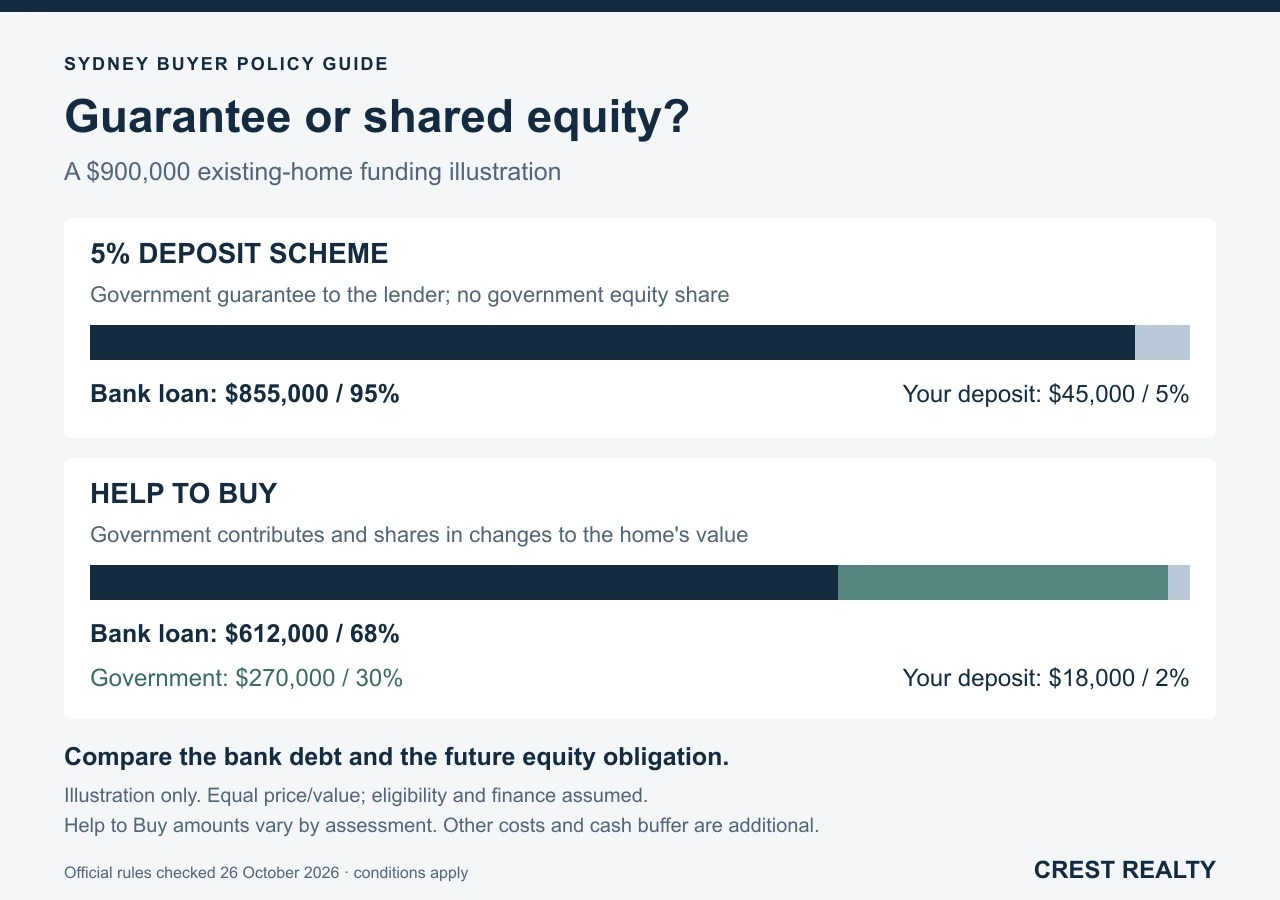
Two ways to bridge a different funding gap
Under the 5% Deposit Scheme, eligible first-home buyers can buy with a minimum 5% deposit without Lenders Mortgage Insurance (LMI). The Government supports the lender; it does not pay your deposit or acquire an equity share. You remain responsible for the loan and costs. There is no scheme income cap or limit on places, but the lender must approve your borrowing. See the official first-home-buyer pathway.
Under Help to Buy, the Government contributes up to 30% for an existing home or 40% for a new home, with a minimum buyer deposit of 2%. Your loan can therefore be smaller. There are 10,000 places each year. You hold legal ownership, while the Government has a financial interest in the home's value. It shares gains and losses when its interest is repaid. See the Help to Buy overview.
Help to Buy has no regular rent or interest payment to the Government. Its share still needs to be repaid; the bank loan has its own repayments. A smaller bank balance does not remove the future equity obligation.
Eligibility: the differences that can change your options
On a phone, swipe the table sideways to compare both columns.
| Check | 5% Deposit Scheme — first-home pathway | Help to Buy |
|---|---|---|
| Age and residency | At least 18; Australian citizen or permanent resident | At least 18; all applicants must be Australian citizens |
| Property history | First-home buyer, or no Australian property/land ownership in the previous 10 years | No current property or beneficial ownership in Australia or overseas; limited single-parent exceptions |
| Joint application | Alone or with one other eligible applicant | Alone or with one other eligible applicant |
| Use of home | Owner-occupied; investment purchases excluded | Principal residence while participating; rental arrangements restricted |
| Income | No scheme income cap; lender serviceability applies | Indexed taxable-income limits and a financial-capacity assessment |
Sources: 5% first-home eligibility and Help to Buy eligibility. These are selected differences, not a complete eligibility assessment.
For 1 July 2026 to 30 June 2027, Help to Buy's taxable-income limits are $103,000 for an individual and $165,000 for joint applicants or a single parent. The current assessment uses the FY2026 ATO Notice of Assessment. Thresholds are indexed; check again if your application crosses a financial year. Source: 2026–27 income and threshold update.
Help to Buy also requires your maximum reasonable contribution, rather than automatically allowing you to keep all savings beyond 2%. If your resources and borrowing capacity can fund the home without assistance, you are ineligible. Ask the participating lender how it treats an emergency buffer. Source: Help to Buy funding FAQs.
Sydney price caps are currently different
For Sydney, the published Help to Buy cap is $1.3 million, compared with $1.5 million under the 5% Deposit Scheme. These also apply to the specified NSW regional centres; both publish an $800,000 cap for other NSW areas. Check the exact suburb/postcode rather than assuming every NSW property has the Sydney limit. Sources: Help to Buy caps and 5% Deposit Scheme caps.
For the 5% scheme, both purchase price and lender-assessed value must meet the cap. Separate land/build contracts are tested on their combined cost. A cap is an eligibility ceiling, not your approved budget. Finance, valuation and contract conditions still matter.
A $900,000 illustration: compare debt as well as deposit
Assume an established home with a purchase price and accepted valuation of $900,000, approved finance, and a buyer eligible for each alternative. For illustration only, Help to Buy uses the maximum 30% contribution and the minimum 2% deposit; an actual assessment may require different amounts. This is a comparison of alternatives, not simultaneous participation.
| Purchase funding | 5% Deposit Scheme | Help to Buy |
|---|---|---|
| Buyer deposit | $45,000 (5%) | $18,000 (2%) |
| Government purchase contribution | $0 | $270,000 (30%) |
| Bank loan | $855,000 (95%) | $612,000 (68%) |
| Total | $900,000 | $900,000 |
The hypothetical Help to Buy loan is $243,000 smaller. At the same interest rate and term, that means lower scheduled bank repayments. Compare actual lender rates, fees and approval conditions before drawing a personal conclusion.
Neither column includes conveyancing, inspections, applicable duty, registration, moving costs or a cash buffer. Use our buying-costs calculator and mortgage repayment calculator to explore assumptions. Calculator results do not establish scheme eligibility.
Help to Buy after settlement: reviews, changes and exit
Plan for reviews. Reviews occur at least every five years, and can occur earlier. Income above the threshold for two consecutive financial years can trigger a requirement to repay some or all of the Government's share, subject to financial capacity. Keep the home maintained, insured and your principal residence; notify Housing Australia about relevant changes. Source: Help to Buy ongoing-eligibility FAQs.
Plan for a valued buyback. Voluntary partial repayments are generally at least 5% of the home's current value, rounded to the nearest $1,000; full repayment is also possible. Valuation and administration costs apply. On sale, the Government's share is calculated using the greater of sale price and current valuation. Source: Customer Guide, pages 39–41.
For example, assume the Government's share stays at 30%, with no improvements or previous buybacks. At a future value of $1.05 million, a full equity buyback would be $315,000; at $750,000, $225,000, before transaction costs. These are hypothetical valuations, not forecasts. Your remaining bank debt is a separate obligation.
Plan before refinancing or renovating. Refinancing to a non-participating lender requires full government buyout. Major works and share adjustments have notification, approval and valuation rules. Read the Customer Guide and your General Terms with your adviser before committing. The guarantee route has ongoing owner-occupation obligations too; breaching them can end the guarantee and create extra lender costs.
Can you combine assistance, or use these for an investment?
You cannot combine Help to Buy with the 5% government guarantee for the same purchase. Duty concessions, grants and FHSS may be compatible, subject to each program's separate eligibility. Sources: Help to Buy compatibility FAQs and our NSW first-home assistance overview.
Both routes are intended for a home you live in. Do not choose a property assuming you can immediately lease it or later turn it into a rental while retaining assistance. Discuss future moves and required permissions before relying on that strategy.
Turn a funding comparison into a property brief
Ask your participating lender to confirm which route is available, your realistic purchase limit, total cash needed and the implications of a future move, refinance or buyback. For more on the guarantee route, read our 5% deposit and 95% loan guide.
Then compare homes using the same budget and priorities: location, layout, running costs, condition and contract timing. Crest Realty can help you explore Sydney buying options and land and house-and-land projects within your confirmed search parameters. A project being advertised does not establish its scheme eligibility.
Contact Crest Realty about your property search. Loan approval and scheme assessment sit with participating lenders; legal and financial advisers can help you assess the obligations before signing.
General information only, not personal credit, legal or financial advice. Rules and availability can change. Confirm current requirements and your own circumstances with the administering agency, participating lender and independent advisers.