
The First Home Super Saver scheme can help eligible buyers build part of a home deposit through voluntary super contributions. It does not give you access to your entire super balance. Before contributing, work out whether the tax treatment, access conditions and purchase timing fit your plans.
FHSS is administered by the Australian Taxation Office (ATO). It is a deposit-saving arrangement, separate from a home loan or government loan guarantee. Start with the Government's FHSS overview, then check the detailed ATO rules.
Policy checked: 27 October 2026. The timing below is for a new FHSS determination made under the rules applying from 15 September 2024. Earlier determinations can have different deadlines.
1. Start with eligibility and your purchase plans
You must be 18 or older when requesting a determination, although eligible contributions can have been made earlier. Generally, you must never have owned Australian property, including investment property or vacant land; an ATO financial-hardship exception may apply. Your name must be on the purchased title, and a completed previous FHSS release prevents another use.
Eligibility is individual: a co-buyer's previous ownership does not automatically prevent an otherwise eligible person from using FHSS. Check your own position rather than assuming every “first-home” program uses the same definition. Source: ATO eligibility requirements.
You must intend to occupy the home as soon as practicable, and live there for at least six months in the first twelve months from when occupation becomes practicable. Vacant land alone does not satisfy the home purchase requirements; construction has additional timing considerations. Source: ATO purchase considerations.
2. Check which contributions can count
Common eligible contributions made from 1 July 2017 are:
| Contribution | FHSS treatment, subject to eligibility and limits |
|---|---|
| Voluntary salary sacrifice | Concessional contribution; the releasable contribution component is 85% |
| Personal contribution with a tax deduction claimed or intended | Concessional contribution; the releasable contribution component is 85% |
| Eligible personal after-tax contribution without a deduction | Non-concessional contribution; the releasable contribution component is 100% |
| Compulsory employer Super Guarantee | Not available for FHSS release |
Sources: ATO contribution rules and the official FHSS fact sheet.
Eligible concessional contributions are generally taxed at 15% in the fund. That may compare favourably with your marginal income-tax rate, but release tax and your circumstances also matter. FHSS does not guarantee a particular tax saving.
The list is not exhaustive. Mandatory award contributions and contributions made for you by a spouse or family member are also excluded. Ordinary super contribution caps still apply; FHSS is not an extra contribution allowance. Before choosing an amount, ask your fund and tax adviser to check the contribution type, employer payments, caps and any deduction paperwork.
Use fund records to verify receipt dates and amounts. A payslip deduction does not prove money reached the fund in that financial year. Check whether your fund releases FHSS amounts and whether fees or insurance consequences apply. Source: official FHSS fact sheet.
3. Separate contribution limits from money available to spend
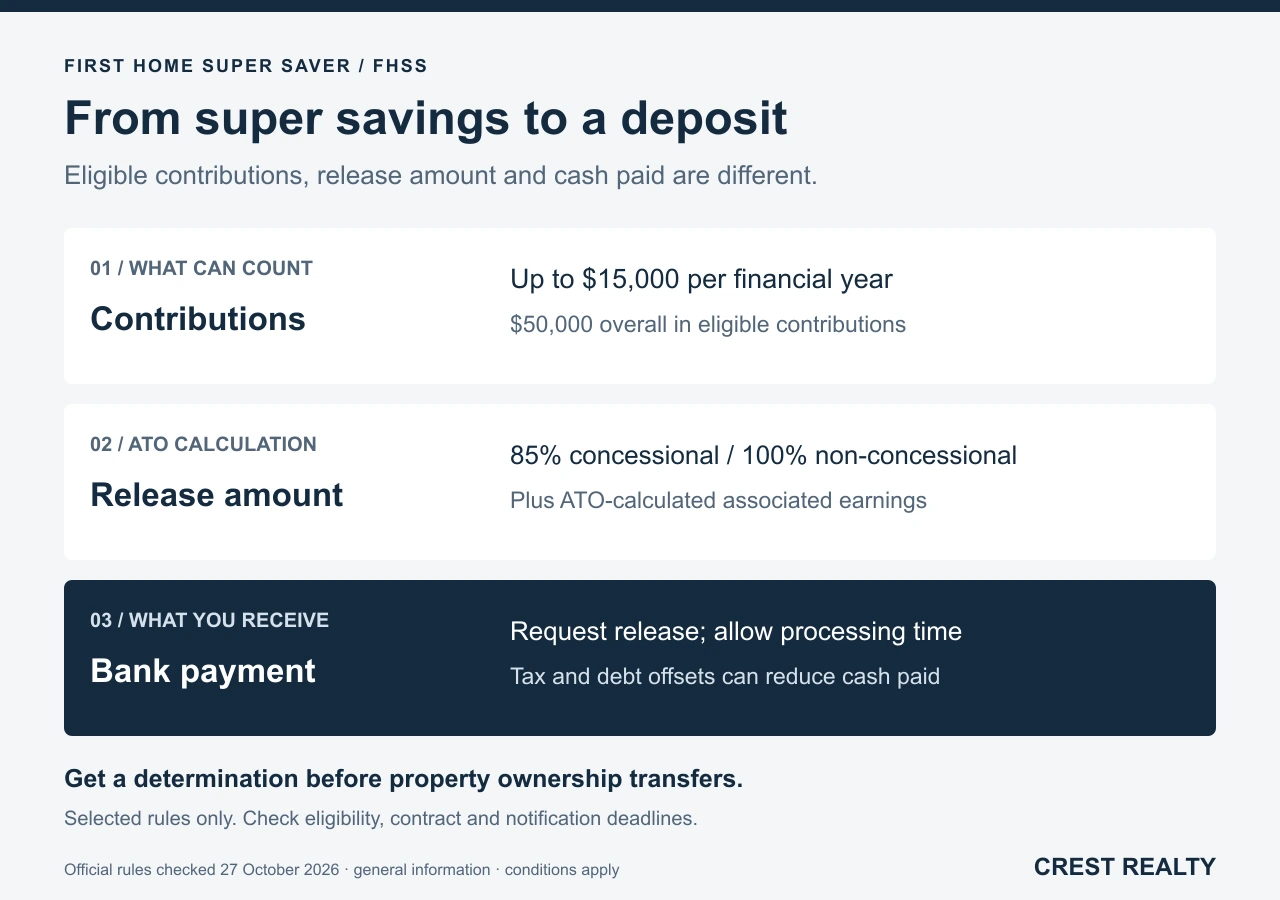
At most $15,000 of eligible contributions per financial year and $50,000 across all years can count. Those limits apply to the contributions in full, before the 85% concessional adjustment. The ATO then adds associated earnings, calculated under its rules rather than simply taking the fund's actual investment return. Ordering rules can affect a mixture of contribution types. Source: ATO maximum release amounts.
The amount arriving in your bank can be lower after tax withholding and applicable government-debt offsets. The ATO's nominated withholding rate generally uses your expected marginal rate including Medicare levy, less a 30% tax offset; it uses 17% if it cannot estimate that rate. Withholding applies to the assessable component, including releasable concessional contributions and associated earnings, rather than the non-concessional contribution component. Source: ATO receiving your release.
Hypothetical example: contributions are not the bank payment
Assume an eligible person makes $10,000 of voluntary concessional contributions in each of two financial years, with no other contributions using their FHSS limits. Assume the ATO calculation adds $500 of associated earnings. This is an invented amount, not a quoted return.
| Calculation | Illustrative amount |
|---|---|
| Eligible contributions across two years | $20,000 |
| Releasable contribution component: 85% | $17,000 |
| Assumed associated earnings | $500 |
| Amount before release withholding | $17,500 |
| Assumed withholding: 9% of $17,500 | $1,575 |
| Cash paid, assuming no debt offset | $15,925 |
The 9% assumption uses an expected marginal rate of 39% including Medicare levy, less the 30% offset. Actual tax depends on the person's circumstances; withholding is not the final tax assessment. This example does not compare the same after-tax cost of saving inside and outside super, or promise a particular saving.
4. Treat determination, release and contract notification separately
First, obtain an ATO determination before property ownership transfers to you. It confirms the maximum release amount; it is not a payment. Request it early and check the details before asking for funds. A determination is also required before making a release request. Sources: ATO determination timing and release requests.
Second, request the release. Include the total you intend to access; changes or cancellation stop once the ATO starts processing the payment. The ATO says receipt generally takes 15–20 business days, so do not assume funds will cover a contract deposit due immediately.
For current determinations, you can request release before signing, or within 90 days after signing. The relevant contract window generally runs from 90 days before the release request to 12 months after it. A further 12-month extension is generally granted and notified by the ATO, up to 24 months after the request. Notify the ATO within 90 days of signing, unless it allows another period. Source: ATO contract and notification requirements.
Keep a separate cash plan for exchange, settlement and other costs. A statutory application window does not extend your contractual payment deadline. Discuss the timetable with your lender and conveyancer before committing.
5. Buying land, changing plans and the tax return
Land and construction: obtain the determination before land ownership transfers. Buying a block does not, by itself, complete the FHSS home-building requirements. Check the construction-contract timing with the ATO and align it with your finance. Our 5% deposit house-and-land guide covers a separate scheme's conditions; meeting those does not establish FHSS compliance.
If you do not buy: check the ATO's recontribution and notification rules promptly. The required recontribution is generally at least the assessable released amount less tax withheld, made as a non-concessional contribution without a deduction. Recontributing does not restore another FHSS opportunity. Keeping the amount, or failing the requirements, can trigger 20% FHSS tax on the assessable released amount, in addition to applicable income tax. Sources: ATO post-release obligations and FHSS tax assessment.
Tax return: report the assessable amount and tax withheld in the financial year of the release request, which can differ from the payment year. Use the ATO payment summary and get tax advice where needed. Source: ATO tax-return instructions.
6. Connect the savings plan to a realistic property budget
FHSS can sit alongside other assistance, but each program has separate conditions. Use our NSW first-home assistance overview and 5% deposit loan guide to frame the questions for your lender and advisers. The buying-costs calculator can help organise costs beyond the deposit.
Once funding is clearer, compare Sydney buying options and land and house-and-land project information against a confirmed budget, location and move-in needs.
Contact Crest Realty about your property search. We can help with property options and available information; your fund, ATO, participating lender and independent advisers confirm super access, tax and finance.
General information only, not personal superannuation, financial, credit, legal or tax advice. Check current rules and your own eligibility before making contributions, requesting release or signing a contract.