
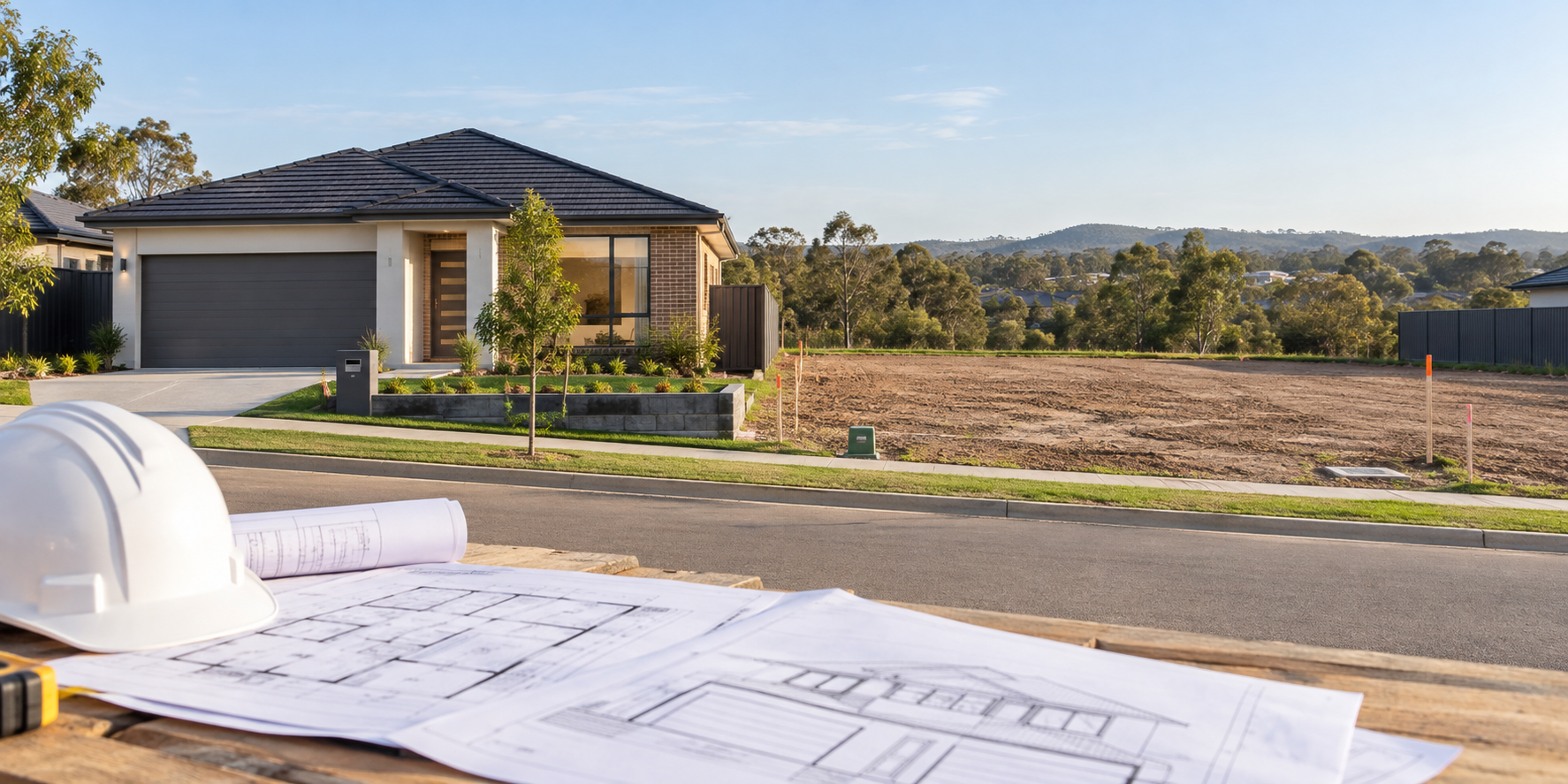
A house and land package can provide a structured path from vacant land to a newly built home. It can also involve more decisions, contracts and timing dependencies than buying an established property.
The words “house and land package” describe a marketed combination, not necessarily one standard legal product. In many transactions, the land is sold under a contract for sale and the home is constructed under a separate building contract. Other arrangements may be structured differently. The parties, deposit requirements, settlement timing and buyer obligations therefore need to be checked in the actual documents.
This guide explains the typical process for buyers considering house and land packages in South West Sydney. It is general information only. Obtain independent legal, financial, taxation, planning and building advice before entering a contract.
1. Start with the land, not only the floor plan
A package usually begins with a particular block of land and a proposed home design. The design must work with the block’s dimensions, slope, orientation, easements, services, setbacks and planning controls.
Before treating a package as suitable, confirm:
- whether the land is registered or still awaiting registration;
- the lot frontage, depth and total area;
- the location of easements, services and restrictions;
- whether the proposed home has been assessed against the actual lot;
- whether estate or developer design guidelines apply;
- whether retaining, cut and fill or other site works are expected; and
- which outdoor works and finishing items are excluded.
A floor plan that appears to fit by width alone may still require changes. Garage access, private open space, setbacks, solar orientation, drainage and the location of services can all affect the final design.
If you are considering Menangle Park, our guide to buying land in Menangle Park explains registration, design controls and lot-specific due diligence in more detail.
2. Understand who is selling the land and who is building the home
Ask for a clear explanation of every party involved. Depending on the transaction, these may include:
- the landowner or developer;
- the real estate agency marketing the opportunity;
- the licensed builder;
- your solicitor or licensed conveyancer;
- your lender or mortgage broker;
- the designer or building consultant;
- the principal certifier; and
- the relevant council or approval authority.
The land contract and building contract may be with different businesses. Promises made in marketing material should be checked against the documents that legally bind each party.
The NSW Government recommends that off-the-plan buyers find out whether there are separate contracts for the land and construction and understand how those contracts interact. Read the NSW guidance on buying property off the plan and have your legal adviser review the proposed arrangement.
Important timing questions include:
- When must the land contract be exchanged?
- When is the building tender or price valid until?
- What happens if land registration or settlement is delayed?
- Is the building contract conditional on owning the land or obtaining finance?
- Can the home design or price change before construction starts?
- What happens if approval is refused or additional site works are required?
Do not assume the land and building components will automatically remain aligned if one part is delayed.
3. Compare the complete price, not the advertised package figure
An advertised package price may not represent the final amount needed to purchase the land, obtain approval, build the home and make it ready to occupy.
Request a written, itemised schedule showing what is included and excluded. Depending on the package, additional costs may include:
- transfer duty and conveyancing;
- lender valuation and loan fees;
- surveys, soil tests and engineering;
- development, certification and authority fees;
- estate design-review fees;
- site works, piering, retaining or spoil removal;
- service connections and meters;
- façade, electrical or internal-finish upgrades;
- flooring, blinds and air conditioning;
- driveway, fencing, landscaping and letterbox;
- bushfire, acoustic, flood or other site-specific requirements;
- variations made after signing; and
- rent, storage or temporary accommodation during construction.
Pay particular attention to allowances described as prime cost items or provisional sums. Ask what assumptions support each allowance, what happens if the actual cost is higher and what builder’s margin applies to changes.
A useful comparison places competing packages on the same scope. A lower base price is not necessarily a lower completed cost if essential items are missing or allowances are unrealistic.
4. Arrange independent contract reviews
The land contract should be reviewed by your solicitor or licensed conveyancer before exchange. The building contract should also be reviewed carefully, particularly if the standard terms have been amended or special conditions have been added.
NSW guidance states that residential building work over $20,000 should use a large-job written contract. The maximum deposit under NSW home building law is 10% of the contract price. For work requiring Home Building Compensation cover, the contractor must provide evidence of that cover before taking money, including the deposit.
Before signing the building contract, check:
- the builder’s licence matches the contracting entity and proposed work;
- the approved plans and full specifications are attached;
- inclusions, exclusions and allowances are clearly identified;
- the contract price and permitted adjustment mechanisms are understood;
- the construction period, extension-of-time rules and delay procedures are clear;
- progress payments relate to completed stages or work already performed;
- the variation process requires proper written documentation;
- responsibility for approvals, design compliance and authority fees is clear;
- insurance requirements have been satisfied; and
- termination, dispute and defect procedures are understood.
Use the NSW residential building contract guidance and the NSW Fair Trading contract checklist as starting points. They do not replace advice on your specific contract.
5. Coordinate finance across the land and construction stages
House-and-land finance may involve a land loan followed by a construction facility, or another structure determined by the lender. Approval for the land purchase does not necessarily mean the lender has unconditionally approved the final building contract.
Discuss the full proposal with your lender or broker before committing. They may need:
- the land contract and valuation;
- the signed building contract;
- approved plans and specifications;
- evidence of your deposit and available funds;
- the progress-payment schedule;
- insurance and approval documents; and
- updated information if registration, settlement or construction is delayed.
Construction loans are commonly drawn progressively. At each contractual stage, the builder issues a payment claim and the lender may require authorisation, an inspection or other evidence before releasing funds.
The NSW Planning Portal’s construction guidance states that a builder cannot ask for a progress payment in advance of the work being carried out. Additional payments outside the contractual schedule may also affect Home Building Compensation protection.
Keep a contingency for items the lender does not fund, valuation shortfalls, variations and living costs during the build.
6. Confirm the planning and certification pathway
A proposed home may require:
- a Development Application followed by a Construction Certificate; or
- a Complying Development Certificate if the land and design meet all applicable standards.
The correct pathway depends on the site and proposal. A standard project-home design is not automatically eligible for complying development.
Before construction starts, confirm:
- the design has any required estate or developer approval;
- the relevant planning or complying-development approval has been issued;
- required conditions have been satisfied;
- the plans used for approval match the contracted design;
- a principal certifier has been appointed by the owner; and
- the lender has issued its formal authority to commence construction.
According to the NSW Planning Portal’s pre-construction guidance, the owner must engage the principal certifier. The certifier conducts mandatory inspections and may issue an occupation certificate when the completed work satisfies the applicable requirements. The certifier’s regulatory role is different from supervising the builder or guaranteeing the quality of every finish.
7. Make selections and document variations carefully
Builders commonly set deadlines for colours, electrical layouts, fixtures, flooring and other selections. Decisions made after signing can change price, approval documents and construction timing.
Before approving a variation, ask for:
- a written description of the change;
- the price increase or credit;
- any builder’s margin or administration fee;
- any effect on plans, approvals or engineering;
- the effect on the completion date; and
- confirmation of how the variation will be funded.
Keep the signed contract, plans, specifications, selection schedules, variations, invoices, payment records, inspection reports and correspondence in one organised file. Verbal assurances are difficult to rely on if they are not reflected in the contract or an approved written variation.
8. Follow the build through inspections and progress payments
The building contract should define the stages and payment amounts. Common labels may include base, frame, enclosed or lock-up, fixing and completion, but the actual definitions in the contract control.
Before authorising a stage payment:
- compare the builder’s claim with the contractual stage definition;
- confirm the claimed work has been completed;
- check whether your lender requires a valuation or inspection;
- retain copies of the invoice and payment authority; and
- raise concerns promptly and in writing.
The principal certifier performs mandatory regulatory inspections. Buyers may also consider engaging an appropriately qualified independent building inspector at suitable stages. An independent inspection serves a different purpose from the principal certifier’s statutory role.
9. Complete pre-handover checks
Near completion, the builder will usually arrange a practical-completion or handover inspection. Review the contract to understand the required process, the treatment of incomplete or defective items and when final payment becomes due.
Check that you receive the relevant documents, which may include:
- the occupation certificate;
- warranties and appliance manuals;
- certificates for installed systems or specialist work;
- keys, remotes and access devices;
- final approved plans and variations;
- insurance information;
- maintenance instructions; and
- a written defects list and agreed rectification process.
The principal certifier issues an occupation certificate only when the applicable requirements are met. The NSW post-build guidance explains that buyers should not move into a new home before the required occupation certificate has been issued.
NSW statutory warranties generally apply for six years for major defects and two years for other defects, calculated from completion. Contractual defect periods and statutory rights are not necessarily the same, so obtain advice if a problem arises.
10. Check current first-home-buyer assistance
Eligibility and thresholds depend on the buyers, contract dates, property values and intended occupation. Do not include a grant or duty concession in your available funds until eligibility has been confirmed.
As at 30 July 2026, Revenue NSW states that:
- the First Home Owner Grant for an eligible new home is $10,000;
- for vacant land plus a comprehensive home building contract, the combined land value, building contract and variations must not exceed $750,000 for the grant; and
- separate transfer-duty assistance may be available to eligible first-home buyers under the First Home Buyers Assistance Scheme.
Rules can change. Review the current Revenue NSW First Home Owner Grant and First Home Buyers Assistance Scheme, then confirm your position with your lender and legal or financial adviser.
A practical house-and-land checklist
Before committing to a package, confirm that you have:
- identified every contracting party;
- obtained independent advice on the land and building contracts;
- checked land registration, title matters and design controls;
- confirmed the proposed home is suitable for the actual lot;
- received a detailed inclusions, exclusions and allowance schedule;
- budgeted for site works, approvals, finishing items and contingency;
- confirmed the builder’s licence and Home Building Compensation cover;
- aligned finance approval with land settlement and construction timing;
- understood the approval and certification pathway;
- reviewed the progress-payment and variation procedures; and
- planned for inspections, handover and post-completion defects.
Frequently asked questions
Is a house and land package one contract?
Not always. Many packages involve a land contract with the landowner or developer and a separate building contract with a builder. Other structures are possible. Your legal adviser should explain the parties, obligations and interaction between all documents.
Is the advertised package price fixed?
It depends on the written documents. Site costs, provisional sums, selections, approval requirements and buyer-requested variations can affect the final amount. Ask for a site-specific tender and complete inclusions schedule.
When do construction-loan repayments begin?
Loan products differ. Construction funds are commonly released through progress draws, and interest may be charged on amounts drawn. Ask your lender or broker to explain repayments, fees and evidence required at each stage.
Can construction start immediately after land settlement?
Not necessarily. The building contract, finance, plans, approvals, insurance, certifier appointment, site preparation and lender’s commencement authority must all be ready. The timing should be confirmed for the specific project.
Who checks the quality of construction?
The principal certifier conducts required regulatory inspections, but does not guarantee the quality of all finishes or supervise the builder for the owner. Buyers may choose to engage an appropriately qualified independent inspector at selected stages.
Discuss South West Sydney opportunities with Crest Realty
Crest Realty can help you identify current land and house-and-land opportunities, compare the practical features of available lots and coordinate the next steps with the relevant builder and professional advisers.
Explore our buying services, view current projects, browse available properties, or contact Crest Realty to discuss your requirements.
Important information: This article provides general information only and does not constitute legal, financial, taxation, planning, building or investment advice. Package availability, prices, inclusions, government rules and approval requirements may change. Buyers should review the actual contracts and obtain advice from appropriately qualified professionals before making a decision.