
Updated September 2026
Western Sydney is entering a new phase of growth. Western Sydney International (Nancy-Bird Walton) Airport is scheduled to welcome its first passengers on 25 October 2026. The airport is being delivered alongside new transport links, employment precincts and planned communities across the Western Sydney Aerotropolis.
This creates a different investment conversation from simply buying “near an airport”. The more important question is whether a location sits within a coordinated growth corridor where jobs, transport, housing and essential services are being planned together.
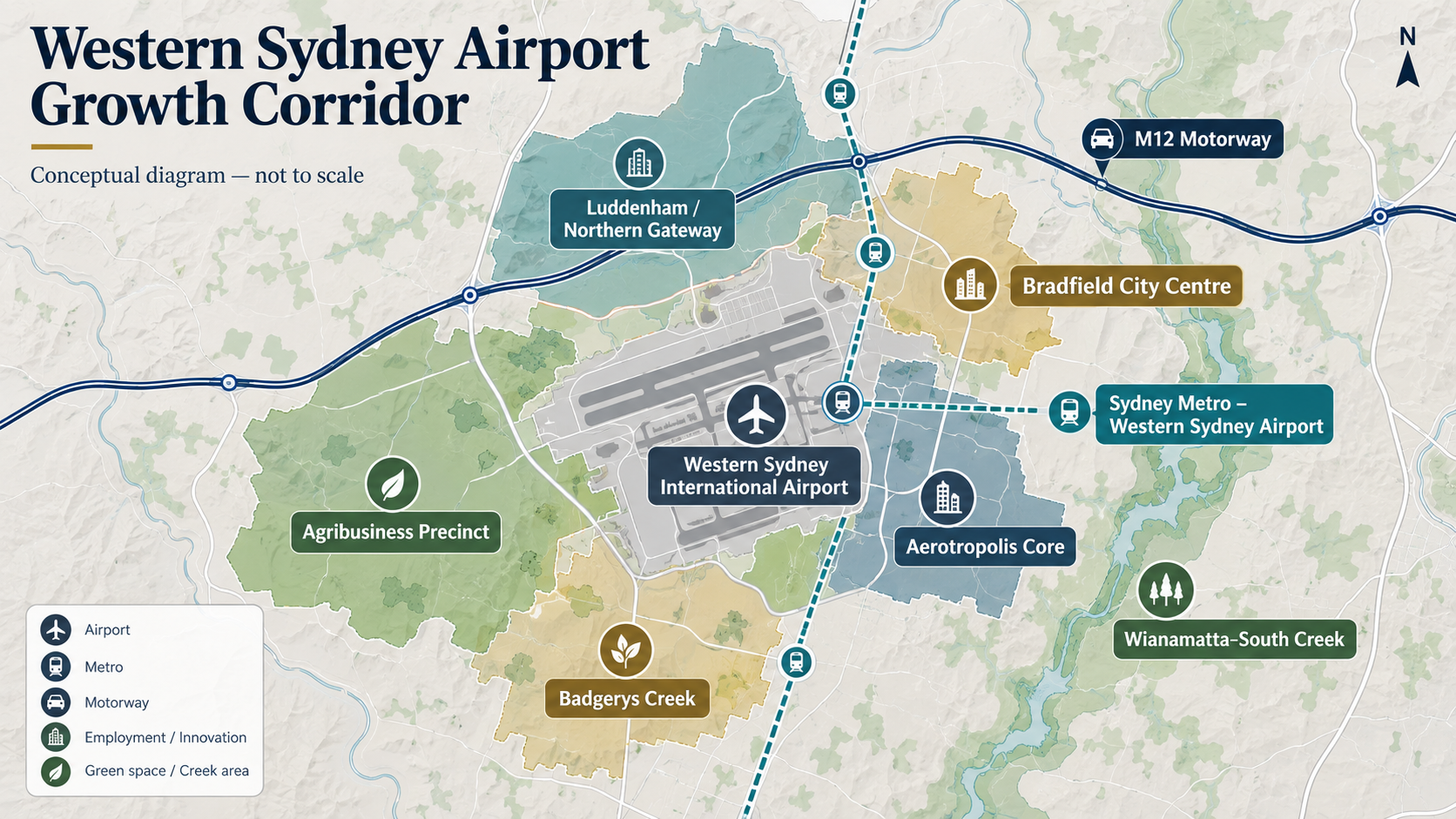
A new airport is changing Western Sydney’s economic map
The Australian Government describes Western Sydney International Airport as a major national infrastructure project designed to support international, domestic and freight activity across the region. The airport is expected to attract investment in manufacturing, logistics, hospitality, education and professional services.
Airports can create demand beyond the terminal itself. They can support supply chains, business travel, freight, tourism and specialist employment. Over time, these activities may influence where people choose to live, work and invest.
The investment case is therefore regional. A property does not need to be directly beside the runway to benefit from improved access to employment and services, but the actual travel time, planning controls and surrounding land uses must be checked carefully.
The Aerotropolis is a network of precincts, not one single suburb
The Western Sydney Aerotropolis includes several distinct planning areas, including Aerotropolis Core, Bradfield City Centre, Northern Gateway, Luddenham, Agribusiness, Badgerys Creek and Wianamatta-South Creek.
Each precinct has a different role. Some areas are intended for advanced industry, logistics, agribusiness or environmental protection, while residential development is concentrated in selected mixed-use and residential locations. Investors should never assume that every parcel near the airport is suitable for a house or house-and-land package.
The NSW Aerotropolis planning framework coordinates land use, infrastructure, employment, open space and environmental management across the initial precincts. Read the NSW Aerotropolis Precinct Plan.
Bradfield City provides an employment anchor
Bradfield City is being planned as a new metropolitan centre at the heart of the Aerotropolis. Its approved master plan has capacity for approximately 10,000 homes and 20,000 jobs, while the broader Aerotropolis is planned to support a much larger employment base.
These jobs are expected to span advanced manufacturing, aerospace, defence, health, freight, logistics, education, research and technology. A more diverse employment base can support different types of housing demand, including workers seeking rental accommodation, families wanting access to new schools and services, and owner-occupiers moving closer to employment.
Employment projections are not guarantees. The responsible approach is to track which projects are funded, under construction or operational, rather than treating every long-term vision as a completed outcome.
Transport is moving from planning towards delivery
The M12 Motorway has opened, providing a toll-free connection to the new airport. Other road projects include upgrades to Elizabeth Drive, Fifteenth Avenue and key Aerotropolis access roads.
The Sydney Metro – Western Sydney Airport project is being delivered to connect St Marys, the airport, Bradfield and the wider Sydney network. These projects can improve access to jobs and services, but the benefit to a particular property depends on its exact location and the final transport network.
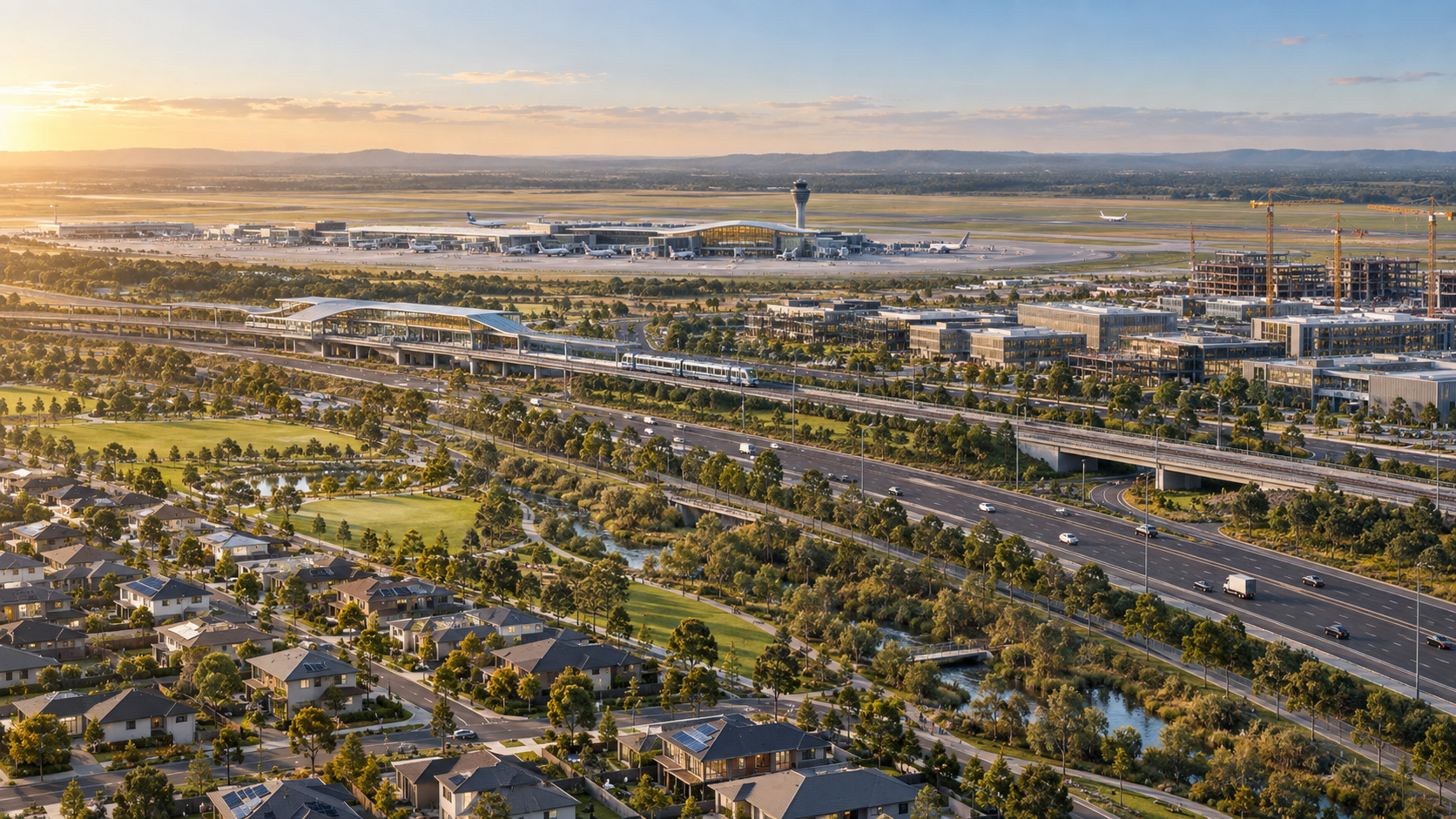
Why airport-side growth areas may suit land and house-and-land investors
New-growth areas can give investors the opportunity to assess both the land and the completed house before committing. A land-and-house strategy may allow closer review of:
- lot location, orientation and registration timing;
- house design, energy efficiency and tenant appeal;
- construction specifications and inclusions;
- site costs, finance requirements and settlement timing;
- the relationship between total cost, comparable sales and realistic rent.
A well-designed new house may appeal to families seeking modern layouts, parking, outdoor space and access to new parks, schools and community facilities. That appeal still needs to be tested against local evidence; a new property is not automatically a high-return investment.
Why the timing may be interesting
The current opportunity is based on the sequence of development: the airport is approaching passenger operations, Bradfield and the Aerotropolis are moving into physical delivery, transport projects are progressing, and private investment is expanding across employment precincts.
This sequencing observation is not a prediction of capital growth. Infrastructure benefits may take years to flow through, and projects can change, be delayed or be redesigned. Investors should compare the price being paid today with the quality and certainty of the future amenity.
How Crest Realty helps investors assess the opportunity
Crest Realty focuses on property opportunities in emerging growth areas, including residential land and house-and-land investments.
Our approach is to assess the complete investment picture rather than relying on a single headline such as “near the new airport”. We help clients review planning controls, infrastructure stages, land characteristics, builder specifications, total costs, rental appeal, holding assumptions and exit options.
The right property is not necessarily the closest property to the airport. It is the opportunity where the location, price, design, timing and risk profile are consistent with the investor’s objectives.
Due-diligence checklist
Before purchasing in an airport-side growth area, investors should verify:
- zoning, title and registration status;
- aircraft flight paths and noise information;
- flood, bushfire, biodiversity and heritage constraints;
- actual transport access and travel times;
- school, retail and community-facility delivery stages;
- site costs, easements and design guidelines;
- Housing and Productivity Contribution obligations;
- construction contract inclusions, exclusions and variation rules;
- finance, land tax, insurance and vacancy assumptions;
- comparable sales and realistic rental evidence.
The former Western Sydney Growth Areas and Aerotropolis infrastructure contribution schemes transitioned to the Housing and Productivity Contribution framework from 1 July 2026. Buyers should confirm which charges apply to each property and whether they are included in the contract price. Check the NSW Housing and Productivity Contribution guidance.
Official resources
- Australian Government: Western Sydney International Airport
- NSW Planning: Western Sydney Aerotropolis
- NSW Government: Aerotropolis investment update
- NSW Budget: South-West Sydney infrastructure
Disclaimer: This article provides general information only and is not financial, tax, legal or investment advice. Infrastructure plans, planning controls, costs and market conditions may change. Obtain independent professional advice before making a property or investment decision.